Abstract
Artificial intelligence (AI) is rapidly changing global finance, challenging many of the theories that guide current financial research. Most studies focus on how AI improves prediction, automation, and efficiency, but they often overlook a deeper shift: AI is now playing a larger role in creating financial knowledge, shaping who holds authority, and influencing how decisions are made. This paper aims to fill that gap by introducing the Theory of Algorithmic Financial Cognition (TAFC). This new framework sees AI not just as a tool, but as a growing cognitive system that shapes how financial information is created, understood, and used in the markets.
The paper builds TAFC using research from finance, artificial intelligence, governance, organizational theory, and cognitive science. It is based on five main ideas: Cognitive Delegation, Algorithmic Interaction, Algorithmic Learning, Cognitive Opacity, and Cognitive Governance. This framework shows how AI changes the way financial decisions are made across markets, wealth management, risk management, and financial institutions, creating new systems in which humans and AI work together in ways that differ from traditional finance models.
The paper also argues that this shift in how decisions are made brings new types of risk, such as algorithmic, epistemic, systemic, and cognitive risks, which current risk models do not fully address. Because of this, the paper suggests that financial governance should also evolve. Regulators should focus not just on financial activities, but also on how algorithms think and make decisions, with an emphasis on explainability, accountability, human oversight, and international cooperation.
In addition to its theory, the paper sets out a research plan. It identifies key concepts, suggests testable ideas, and offers ways to study and expand TAFC in different financial settings. This approach aims to make Algorithmic Financial Cognition the basis for ongoing research that brings together finance, artificial intelligence, and governance.
The paper concludes that Artificial intelligence is not merely digitalising financial activities; it is fundamentally transforming the cognitive architecture through which financial knowledge is generated, decisions are made, and risks are governed. To understand this change, we need to look beyond technology alone and use the TAFC to guide future research and global financial rules.
Background
AI is rapidly transforming global financial markets, influencing investment decisions, market behavior, portfolio management, and financial governance. While research has focused on AI as a tool for improving efficiency and analytics, the growing autonomy of intelligent systems means AI increasingly shapes how financial knowledge is produced, interpreted, and translated into market decisions (Aldasoro et al. 2024).
Research Gap
Although research on AI-driven finance is expanding, it remains fragmented across areas such as algorithmic trading, risk management, and regulation. Most studies view AI as a computational tool, overlooking its broader role as a transformative cognitive infrastructure. As a result, there is limited theoretical understanding of how AI reshapes financial cognition, shifts decision-making authority, introduces new systemic and epistemic risks, and challenges traditional governance models (Krakowski & Luger 2022).
Central Thesis
This paper contends that the financial system is experiencing a cognitive transformation, with AI functioning as an autonomous cognitive infrastructure. AI is not just automating tasks but redefining how financial knowledge is generated, interpreted, validated, and applied across global markets. This shift fundamentally changes market dynamics, institutional decision-making, systemic interactions, and governance needs.
Theoretical Contribution
The paper presents toward a (TAFC) Framework, which explains how AI transforms financial markets through knowledge generation, algorithmic decision-making, adaptive learning, cognitive opacity, and systemic interaction. By focusing on cognitive transformation rather than automation, the framework offers an integrated explanation of structural changes in AI-driven financial ecosystems and supports future research.
Policy Contribution
Building on this framework, the paper proposes a governance approach that moves beyond traditional financial regulation to supervise autonomous cognitive infrastructures. It argues that future financial stability will depend on governance models that ensure transparency, accountability, explainability, human oversight, and international regulatory coordination in AI-enabled financial systems.
Keywords
Artificial Intelligence. Algorithmic Financial Cognition. Financial Governance. Cognitive Infrastructure. Algorithmic Decision-Making. Financial Stability. Systemic Risk. Wealth Management. Capital Markets. AI Regulation.
1. Introduction
1.1 Background: The Global Transformation of AI in Finance
The global financial system is being fundamentally transformed by the rapid integration of AI, advanced analytics, and algorithmic decision-making. Historically, financial markets relied on human expertise and institutional knowledge, with investment decisions based on the interpretation of financial statements, macroeconomic indicators, and market sentiment. Today, advances in big data, machine learning, and generative AI are shifting finance toward an environment where algorithms increasingly mediate knowledge creation and decision-making.
The evolution of AI in finance marks a shift from automation to cognition. Early technologies focused on transaction efficiency, cost reduction, and automating repetitive tasks. The introduction of algorithmic trading over the past two decades enabled institutions to execute transactions at greater speed and scale (Hatch et al., 2021). High-frequency trading and quantitative investment firms have shown that competitive advantage now depends on computational power, statistical modeling, and access to large-scale data (High Finance: Harnessing the Power of HPC, n.d.).
Institutions like Renaissance Technologies have demonstrated the value of mathematical and computational approaches to investment management. Firms such as Two Sigma and Citadel Securities have further advanced the use of machine learning, alternative data, and algorithmic models to analyze markets and execute strategies (Two Sigma, 2026). These developments show that algorithms are now central to modern financial intelligence, moving beyond simple automation.
Recent advances in AI have accelerated this transformation by enabling systems to process both numerical and complex, unstructured data. Large language models, natural language processing, and generative AI are now integrated into financial analysis, investment research, compliance, and risk management (Wu et al., 2023. Bloomberg, 2023). For example, Bloomberg’s BloombergGPT is designed for financial applications, processing financial language and supporting specialized tasks (Wu et al., 2023). Morgan Stanley has partnered with OpenAI to provide its advisors with generative AI tools, improving access to research and knowledge resources (Wu et al., 2023).
Major financial institutions have significantly expanded their AI capabilities. JPMorgan Chase, for example, has invested in AI for fraud detection, risk management, investment research, and operational intelligence. The bank’s large-scale AI initiatives involve thousands of specialists working on machine learning and data-driven applications (Wu et al., 2023). These efforts show that AI is now a strategic organizational capability embedded in financial governance (IOSCO, 2021. BIS, 2024).
International financial institutions also recognize this transformation. The Bank for International Settlements notes that AI could reshape financial markets by improving efficiency and analytics, but it also introduces risks related to model complexity, concentration, transparency, and systemic vulnerability (BIS, 2024). The Financial Stability Board highlights concerns about third-party dependency, data concentration, and the opacity of advanced models (Financial Stability Board, 2025).
The significance of AI in finance goes beyond efficiency or predictive accuracy. The deeper change is in the nature of financial cognition. Traditionally, humans produced and interpreted financial knowledge, with analysts gathering information and managers making judgments. AI now challenges this by introducing algorithms that discover patterns, generate interpretations, and produce recommendations that shape financial decisions.
Modern AI systems can simultaneously analyze millions of financial documents, earnings reports, economic indicators, news articles, and social media signals (L.P., 2025). They identify relationships between unrelated variables, generate investment hypotheses, and provide strategic recommendations at a scale and speed beyond human capability (Cao et al., 2021). This marks a qualitative shift: AI is expanding the cognitive capacity of financial organizations.
The emergence of advanced AI models has accelerated this transition. The release of models like DeepSeek-R1 in 2025 showed that sophisticated AI reasoning is becoming more accessible and may reshape global competitive dynamics (DeepSeek's release of an open-weight frontier AI model, 2025). Market reactions to these developments demonstrate that AI progress now influences financial valuation, investment expectations, and market behavior.
The transformation of finance is not simply technological adoption. AIis now embedded in the knowledge architecture of financial systems, shaping how information is processed, signals are interpreted, and decisions are made (IOSCO, 2021. BIS, 2024). This evolution points to a new phenomenon: Algorithmic Financial Cognition, which is the focus of this paper and examines how algorithms actively participate in producing and governing financial knowledge.
1.2 Research Problem: What Existing Literature Fails to Explain
Despite extensive research on AI in finance, most literature focuses on its instrumental capabilities rather than its cognitive and governance implications. Studies have examined AI in stock prediction, portfolio optimization, credit scoring, fraud detection, and risk management, showing that machine learning improves prediction, processes large datasets, and enhances efficiency (Dixon, Halperin and Bilokon, 2020. Goodell, Kumar, Lim and Pattnaik, 2021).
However, this perspective only partially explains the transformation in financial systems. Most approaches view AI as a tool to enhance human decision-making, not as a cognitive structure that contributes to creating financial knowledge.
This paper addresses the gap in current literature regarding how AI has shifted from a computational tool to a cognitive infrastructure in financial governance.
Existing research frequently asks whether AI can improve financial outcomes:
Can AI predict market movements more accurately?
Can AI optimize investment portfolios?
Can AI reduce operational risks?
While these questions remain relevant, they do not address the broader theoretical transformation:
How does AI change the nature of financial cognition itself?
As a result, financial markets now depend on algorithmic systems that not only execute strategies but also generate interpretations, identify hidden relationships, and influence strategic decisions (Aldasoro et al. 2024). For example, AI-driven investment systems can evaluate alternative datasets, analyze geopolitical events, interpret corporate communications, and generate investment signals without direct human involvement.
This shift challenges existing theories of financial governance. Traditional models assume decision authority, accountability, and knowledge production are human-centered. As algorithms take on these roles, new questions emerge about responsibility, transparency, control, and institutional power.
The core research problem is not just AI adoption in finance, but the rise of algorithmic cognition that reshapes how financial knowledge is produced and governed.
1.3 Research Gap: Why AI Cannot Be Viewed Merely as a Technical Tool
Current understanding of AI in finance emphasizes computational capability, efficiency, and predictive performance. However, this perspective does not fully explain the broader transformation of financial systems.
Seeing AI only as a technical tool assumes technology is separate from cognition and governance, with humans creating knowledge and using AI to enhance capabilities. Contemporary AI systems challenge this by actively participating in cognition and governance.
Advanced AI systems perform activities traditionally associated with human cognition:
Identifying patterns,
Interpreting complex information,
Generating hypotheses,
Evaluating scenarios,
Recommending strategic actions.
These functions go beyond automation, signaling the emergence of algorithmic cognitive capabilities within financial decision-making.
The theoretical gap is the lack of a framework that explains AI as cognitive infrastructure, not just as a technological capability.
Recent developments in AI governance highlight this gap. Regulatory initiatives like the European Union's AIAct show that policymakers see AI as requiring governance beyond traditional technology regulation (European Union, 2024). In finance, regulators are concerned with efficiency as well as systemic risks, power concentration, and accountability.
Therefore, understanding AI in finance requires a conceptual shift:
From:
AI as a technological tool applied to finance
Toward:
AI as a cognitive infrastructure shaping financial knowledge and governance.
1.4 Central Thesis: AI as Cognitive Infrastructure
This paper argues that AI has evolved beyond computational technology to become cognitive infrastructure within modern financial systems.
Cognitive infrastructure refers to systems that process information and actively participate in creating, interpreting, and applying knowledge. In finance, AI now performs cognitive functions that influence investment decisions, risk evaluation, and market strategies.
The concept of Algorithmic Financial Cognition captures this transformation. It describes how algorithmic systems analyze financial environments, generate knowledge, and influence governance outcomes.
AI as cognitive infrastructure operates through four interconnected capabilities:
First, information synthesis:AI integrates diverse financial information sources, including market data, economic indicators, corporate disclosures, and textual information.
Second, pattern recognition:AI identifies complex relationships and market signals beyond conventional analytical approaches.
Third, strategic intelligence:AI generates scenarios, evaluates alternatives, and supports strategic financial decisions.
Fourth, adaptive learning:AI systems continuously improve through interaction with new data and changing market conditions.
This transformation challenges traditional assumptions about financial governance. Governance must now address both human institutions and algorithmic systems that increasingly shape financial outcomes.
1.5 Research Contributions
This paper makes three primary contributions.
First Contribution: Theoretical Contribution
The first contribution is introducing Algorithmic Financial Cognition as a new theoretical framework for understanding AI’s role in finance.
Unlike existing perspectives that view AI mainly as a technological capability, this framework sees AI as cognitive infrastructure that produces and governs financial knowledge.
This contribution extends research at the intersection of AI, finance, and organizational theory by explaining how algorithmic systems become embedded in financial cognition.
Second Contribution: Financial Governance Contribution
The second contribution is reframing financial governance for the age of artificial intelligence.
Traditional governance frameworks focus on human accountability, regulation, and control. AI-driven finance, however, requires mechanisms for algorithmic transparency, model accountability, data governance, and human–AI decision relationships.
This paper argues that future financial governance must treat algorithmic cognition as a central analytical category.
Third Contribution: Strategic and Institutional Contribution
The third contribution is to explain the changing architecture of financial power.
Previously, competitive advantage depended on access to capital, market information, and human expertise. In the AI era, it increasingly relies on access to data, computational infrastructure, and algorithmic intelligence (Krakowski & Luger, 2022, pp. 1425-1452).
By introducing Algorithmic Financial Cognition, this paper develops a theoretical foundation for understanding how AI reshapes financial institutions, market competition, and governance.
2. 2. Literature Review
2.1 Evolution of Financial Technologies: From Traditional Finance to AI Finance
2.1.1 Traditional Finance: Human-Centered Financial Cognition
In the past, financial systems depended on people to create, interpret, and make decisions. Investment choices, risk assessments, and capital allocation were based on human expertise, experience, and established theories. Analysts, portfolio managers, and committees made the key decisions and turned information into action.
Classic financial theories like modern portfolio theory (Markowitz, 1952), the Capital Asset Pricing Model (Sharpe, 1964), and the Efficient Market Hypothesis (Fama, 1970) used mathematical models but still relied on human judgment and decision-making. Even as quantitative methods improved, financial thinking stayed focused on people.
At this stage, technology mainly helped with analysis. Computers made calculations, data processing, and statistics easier, but did not change the main source of financial intelligence. Human analysts still produced and interpreted most financial knowledge.
2.1.2 Electronic Finance: The Digitalization of Financial Infrastructure
Electronic finance was the first big change in how technology and finance worked together. Starting in the late twentieth century, financial institutions began using digital systems to automate transactions, improve connections, and make financial services more accessible.
Electronic trading platforms, online banking, automated clearing, and digital payment networks took over many manual tasks. Examples include the rise of NASDAQ and digital changes made by global banks.
Still, electronic finance mostly changed the infrastructure, not how people thought about finance. Digital systems made things faster and bigger, but people and institutions still made the decisions.
As a result, research at the time focused on efficiency, access, transaction costs, and market structure rather than on how technology could develop its own decision-making abilities (Philippon, 2016).
2.1.3 Algorithmic Finance: The Rise of Computational Decision-Making
Algorithmic finance was a big step from just having digital systems to using computers to make decisions. Unlike electronic finance, it introduced systems that make financial decisions using fixed mathematical rules.
Algorithmic trading changed how markets work by allowing automated trades, high-frequency trading, and quantitative strategies. Studies show it made markets more liquid and efficient, but also brought worries about volatility, complexity, and systemic risk (Hendershott, Jones and Menkveld, 2011. Brogaard, Hendershott and Riordan, 2014).
The rise of quantitative hedge funds was another important step. Companies like Renaissance Technologies, Two Sigma, and D.E. Shaw used mathematical models, statistics, and big data, showing that success depended more on uncovering insights from complex data than on traditional analysis.
Still, algorithmic finance mostly followed set rules. Algorithms carried out strategies designed by people, making decisions better, but not creating new financial knowledge on their own.
This difference matters because it separates algorithmic finance from the new idea of algorithmic financial thinking.
2.1.4 AI Finance: From Automation to Cognitive Systems
AItakes financial technology further by introducing systems that can learn, adapt, and generate new knowledge.
Machine learning models are different from traditional algorithms because they do not just follow fixed instructions. They find patterns in data, get better with experience, and make predictions in complex situations.
AI is now used in many areas of finance, including:
Market prediction,
Fraud detection,
Credit scoring,
Portfolio optimization,
Regulatory compliance,
Investment research,
Customer advisory services.
Studies show that machine learning models can identify complex patterns in financial data and predict outcomes more accurately than traditional statistical methods (Sirignano and Cont, 2019).
Recent progress in generative AI has sped up these changes. Large language models can review financial documents, understand market data, and create investment insights. BloombergGPT showed how specialized language models can help with financial tasks (Wu et al., 2023), and companies like Morgan Stanley and JPMorgan Chase are using generative AI for research, advice, and managing knowledge.
These changes show that AI in finance is not just a new technology. It represents a move toward systems that take an active role in financial thinking.
2.2 AI in Financial Markets: Current Research Perspectives
Research on AI in financial markets has increased significantly, mainly focusing on prediction, optimization, and automated decision-making.
One main area of research looks at how machine learning models predict asset prices, returns, and market trends. Studies show that AI models can spot complex patterns that traditional methods might miss (Gu, Kelly and Xiu, 2020). Their work found that machine learning greatly improves predictions by analyzing many financial features.
Deep learning is also used in high-frequency trading, market structure analysis, and predicting volatility. Fischer and Krauss (2018) showed that long short-term memory (LSTM) networks can predict stock markets better than traditional methods.
Still, most research focuses on how accurate AI is at making predictions, treating it mainly as a tool to improve financial results.
For example, AI-powered funds use machine learning to analyze new types of data, such as satellite imagery, consumer behavior, and text. Companies like Two Sigma and other quantitative investors use these tools to find investment signals that traditional analysis might miss.
Even with these advances, current research does little to explain how AI changes financial knowledge itself. Most studies focus on what AI can predict, but rarely discuss how it helps with understanding or managing finance.
2.3 AI in Wealth Management
Wealth management is another important area where AI is changing how financial decisions are made. In the past, wealth management depended on human advisors to understand clients' goals, risk tolerance, and investment preferences. Robo-advisors then introduced algorithms to build portfolios and give financial advice (Morgan Stanley, 2023).
Platforms like Betterment and Wealth front have shown that algorithms can automate investment decisions and provide affordable financial advice. Now, generative AI is being integrated into advisory services to help managers review client data and provide personalized insights.
Morgan Stanley’s work with OpenAI is a good example of this change. They use AI to support advisors and give them better access to company knowledge, not to replace them.
Research on AI in wealth management primarily focuses on efficiency, personalization, and customer experience. It has not focused much on how AI changes the way advisors and clients think and make decisions together.
2.4 AI and Financial Stability
How AIaffects financial stability is now a big concern for international financial organizations.
Groups such as the Bank for International Settlements and the Financial Stability Board point out that AI brings both benefits and risks to the broader system.
Potential benefits include:
Improved risk detection,
Enhanced fraud prevention,
Better market analysis.
However, AI may also introduce new vulnerabilities:
Model opacity,
Concentration among technology providers,
Correlated algorithmic behavior,
Increased market speed,
Greater reliance on automated systems.
The Financial Stability Board (2024) highlighted concerns regarding third-party dependency, data concentration, and the potential for AI-driven financial shocks.
In the same way, the BIS says financial institutions need to develop ways to manage risks posed by more complex AI systems.
Still, most research on financial stability views AI primarily as a technology risk, rather than as something that plays an active role in financial systems.
2.5 Governance Literature
Research on AI governance now places greater emphasis on transparency, accountability, ethics, and human oversight.
AI governance frameworks highlight principles such as explainability, fairness, accountability, and responsible use (OECD, 2019. UNESCO, 2021).
In finance, governance concerns are particularly significant because financial decisions affect economic stability, capital allocation, and social outcomes. Growing recognition that advanced AI systems require dedicated governance frameworks.
However, most AI governance approaches focus on controlling technological systems rather than understanding their cognitive role.
They ask:
How can AI systems be made transparent?
How can risks be regulated?
Who should be accountable?
While these questions are essential, they do not fully address the deeper transformation that occurs when AI participates in the production of financial knowledge (Gu et al. (2020). The review above demonstrates significant progress in understanding AI applications in finance. However, several theoretical gaps remain.
First, most research views AI as just a technology, not as a system that supports financial thinking. Focus on performance outcomes like prediction accuracy and efficiency, with limited attention to how AI transforms knowledge production. They are primarily focused on controlling AI risks but provide insufficient theoretical understanding of AI’s emerging role in financial decision ecosystems.
Therefore, existing literature does not adequately explain the transition from:
Algorithmic Finance → Algorithmic Financial Cognition
This paper aims to fill this gap by suggesting that AI should be viewed not just as a tool in finance, but as a system that helps create, interpret, and manage financial knowledge.
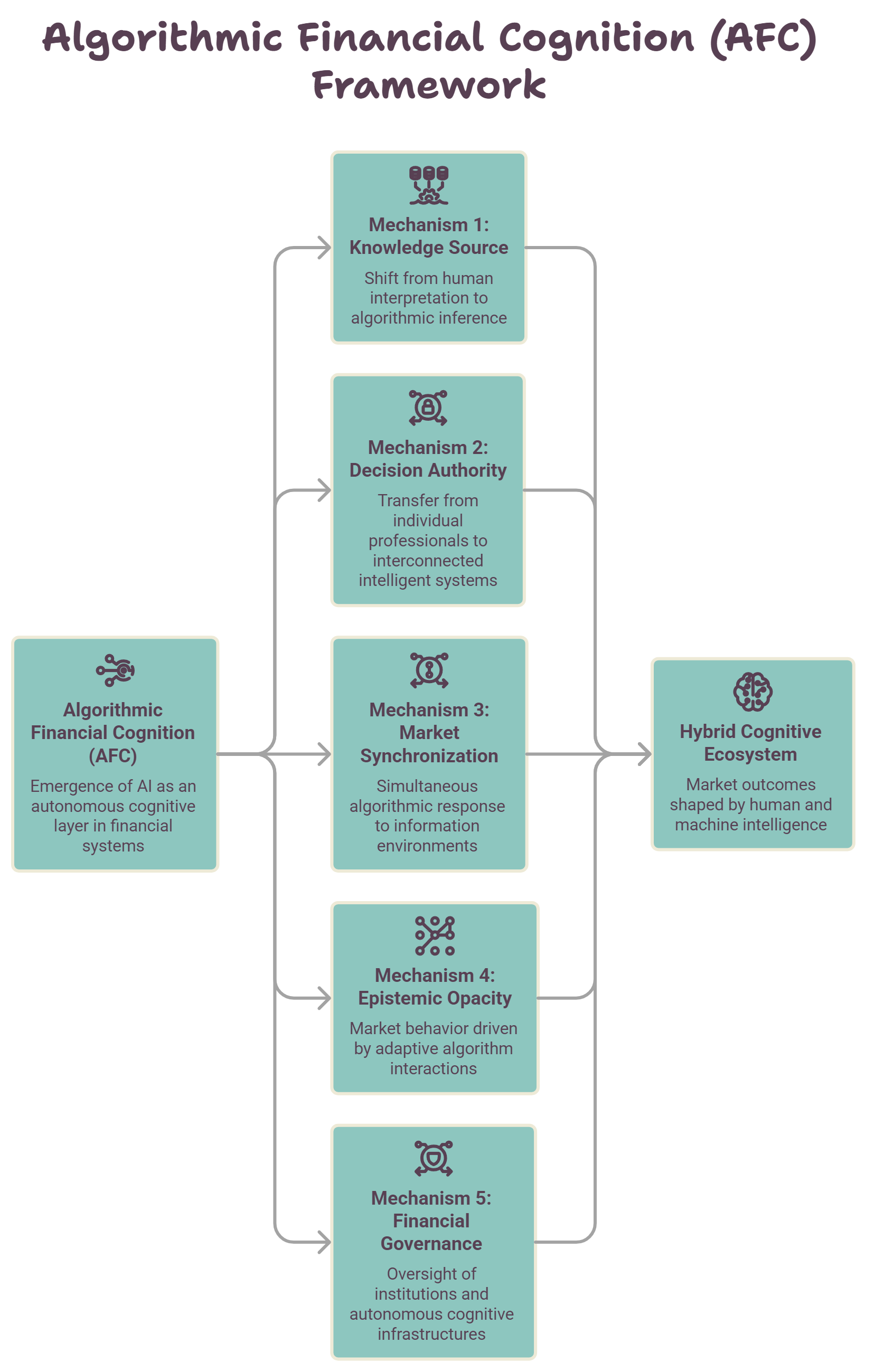
3. Toward a TAFC
3.1 Definition: TAFC
This paper introduces the TAFC as a new theoretical framework for understanding the transformation of financial decision-making, knowledge production, and governance in the age of artificial intelligence.
The central proposition of TAFC is that AI has evolved beyond its traditional role as a computational tool and has become an embedded cognitive infrastructure within financial systems (IOSCO, 2021. BIS, 2024). In this context, algorithms no longer function exclusively as mechanisms for executing predefined instructions. Rather, they increasingly participate in processes traditionally associated with human cognition, including interpretation of information, pattern recognition, prediction, strategic evaluation, and decision support.
Algorithmic Financial Cognition is defined as:
The process by which AI systems acquire, process, interpret, and generate financial knowledge, thereby influencing investment decisions, market behavior, and governance structures via algorithmic cognitive capabilities.
Unlike traditional algorithmic finance, where algorithms primarily execute human-designed strategies, algorithmic financial cognition refers to a higher level of interaction in which AI systems contribute to the creation and transformation of financial understanding itself.
The theory is based on the argument that modern financial markets are increasingly characterized by hybrid cognitive systems in which human intelligence and algorithmic intelligence interacts. In these systems, financial decisions emerge not solely from human judgment or mathematical computation but from complex interactions among:
Human expertise,
Algorithmic models,
Financial data infrastructures,
Institutional objectives,
Regulatory environments.
The emergence of TAFC reflects a broader transformation in the nature of financial intelligence. Historically, financial cognition was located within human institutions such as investment banks, asset management firms, and regulatory organizations. Today, significant elements of this cognition are increasingly distributed across AI systems that analyze vast information environments and generate actionable financial insights.
For example, modern quantitative investment firms increasingly rely on machine learning systems that evaluate thousands of variables simultaneously, including market prices, economic indicators, corporate disclosures, satellite data, consumer behavior patterns, and textual information. Similarly, financial institutions deploying generative AI systems are increasingly using algorithms not only to retrieve information but also to synthesize knowledge and support strategic decision-making.
Therefore, TAFC does not argue that AI possesses human consciousness or independent intentionality. Instead, it proposes that AI systems increasingly perform functional cognitive roles within financial ecosystems.
The key theoretical shift is:
From:
Algorithms as computational instruments supporting financial cognition.
To:
Algorithms as cognitive infrastructures participating in financial cognition.
3.2 Core Assumptions of TAFC
The proposed (TAFC) is built upon five fundamental assumptions.
Assumption 1: Financial Cognition Can Be Partially Algorithmically Distributed
Traditional financial theories assume that cognition resides primarily within human actors and institutions. TAFC challenges this assumption by proposing that elements of financial cognition can be distributed across human and algorithmic systems.
Financial cognition includes activities such as:
Identifying relevant information,
Recognizing patterns,
Evaluating uncertainty,
Generating predictions,
Supporting decisions.
AI systems increasingly perform these functions through machine learning and advanced analytical models.
For example, a modern investment system may analyze millions of data points and identify market signals that influence portfolio decisions without direct human interpretation of each individual factor.
Therefore, cognition in financial systems is becoming increasingly distributed rather than exclusively human-centered.
Assumption 2: Data Has Become a Source of Algorithmic Knowledge Production
TAFC assumes that data is no longer merely an input for financial analysis but has become the foundation through which algorithmic systems generate financial knowledge.
Traditional finance relied heavily on structured information:
Financial statements,
Economic indicators,
Historical prices.
AI-driven finance expands this knowledge base by incorporating:
Alternative datasets,
Textual information,
Behavioral signals,
Real-time market information.
For example, quantitative investment firms analyze satellite imagery, consumer activity indicators, and online information flows to generate investment insights. The value of financial information increasingly depends not only on access to data but also on the ability to transform data into algorithmic knowledge.
Assumption 3: Algorithmic Systems Are Adaptive Rather Than Static
Traditional financial models are generally designed around predefined assumptions and parameters. In contrast, AI systems can adapt through continuous learning.
Machine learning models identify changing relationships within financial environments and adjust their predictions accordingly.
This adaptive capability means that AI systems are not simply executing fixed strategies but continuously modifying their internal representations of financial reality.
However, this adaptability also creates governance challenges because decision processes become increasingly dynamic and difficult to fully predict.
Assumption 4: Cognitive Power Creates New Forms of Financial Power
TAFC assumes that financial power in the AI era increasingly depends on cognitive capabilities.
Historically, financial power was determined by:
Capital availability,
Market access,
Institutional reputation.
In the algorithmic era, additional sources of power include:
Access to high-quality data,
Computational resources,
Advanced AI models,
Algorithmic expertise.
The competitive advantage of financial institutions increasingly depends on their ability to develop and control cognitive infrastructures.
Assumption 5: Algorithmic Cognition Requires New Governance Mechanisms
The final assumption is that traditional financial governance frameworks are insufficient for managing AI-driven financial systems.
When algorithms participate in financial knowledge production, governance must address:
Algorithmic transparency,
Accountability,
Explainability,
model risk,
Human oversight.
The challenge is not only preventing algorithmic errors but also ensuring that cognitive authority within financial systems remains appropriately governed.
3.3 Five Principles of Algorithmic Financial Cognition
Principle 1: Cognitive Delegation
The first principle of TAFC is Cognitive Delegation.
Cognitive delegation is the process by which financial institutions increasingly transfer specific analytical and decision-support functions from human actors to AI systems (Aldasoro et al., 2024).
Historically, delegation in finance involved outsourcing operational tasks such as transaction processing or record management. Under AI-driven finance, delegation extends to cognitive activities.
Examples include:
Automated investment recommendations,
AI-supported risk assessment,
Algorithmic portfolio optimization,
Machine-generated market analysis.
The growth of robot-advisory platforms demonstrates this shift. Platforms such as Betterment and Wealth front use algorithms to construct portfolios, rebalance investments, and provide financial recommendations based on user characteristics (Morgan Stanley, 2023).
However, TAFC argues that cognitive delegation represents more than automation. It changes the location of financial intelligence by moving parts of decision-making capability from humans toward algorithmic systems.
Principle 2: Algorithmic Interaction
The second principle is Algorithmic Interaction.
TAFC proposes that modern financial cognition emerges through interaction between humans and algorithms rather than through isolated algorithmic operations.
Financial decisions increasingly result from hybrid systems where:
Humans define objectives,
Algorithms process information,
Humans interpret outputs,
Algorithms continuously refine recommendations.
Examples include investment analysts using generative AI systems to summarize research reports, evaluate companies, and generate investment scenarios.
The importance of algorithmic interaction lies in the fact that AI does not simply replace human cognition. It restructures the relationship between human judgment and computational intelligence.
Principle 3: Algorithmic Learning
The third principle concerns Algorithmic Learning.
Unlike traditional financial models based on fixed assumptions, AI systems learn from data and adapt to changing environments.
Algorithmic learning enables systems to:
Detect emerging patterns,
Adjust predictions,
Identify new relationships,
Improve decision recommendations.
Deep learning models used in financial prediction demonstrate this capability by discovering complex nonlinear relationships in market data.
However, algorithmic learning introduces uncertainty because models may evolve in ways that are difficult for human operators to fully understand.
This creates a fundamental governance challenge: systems that learn continuously require governance mechanisms capable of monitoring evolving cognitive processes.
Principle 4: Cognitive Opacity
The fourth principle is Cognitive Opacity.
Cognitive opacity refers to the difficulty of understanding how complex AI systems generate their conclusions.
Unlike traditional financial models where assumptions and calculations are relatively transparent, advanced AI systems may operate through complex internal representations that are difficult to interpret.
This issue is particularly significant in financial contexts because algorithmic decisions can influence:
Investment allocation,
Credit access,
Market stability.
The challenge of explainability has been widely recognized in AI governance research, particularly regarding high-impact decision systems (Doshi-Velez and Kim, 2017).
TAFC argues that cognitive opacity is not merely a technical limitation but a fundamental characteristic of algorithmic cognition requiring new governance approaches.
Principle 5: Cognitive Governance
The final principle is Cognitive Governance.
Cognitive governance refers to the mechanisms required to manage, supervise, and regulate systems that participate in financial cognition.
Traditional financial governance focuses on:
Institutions,
Regulations,
Human accountability.
TAFC expands this perspective by including:
Algorithmic accountability,
Model governance,
Data governance,
Human-AI decision structures.
Financial institutions adopting AI systems must therefore develop governance frameworks to ensure that algorithmic cognition remains aligned with institutional objectives, regulatory requirements, and societal expectations.
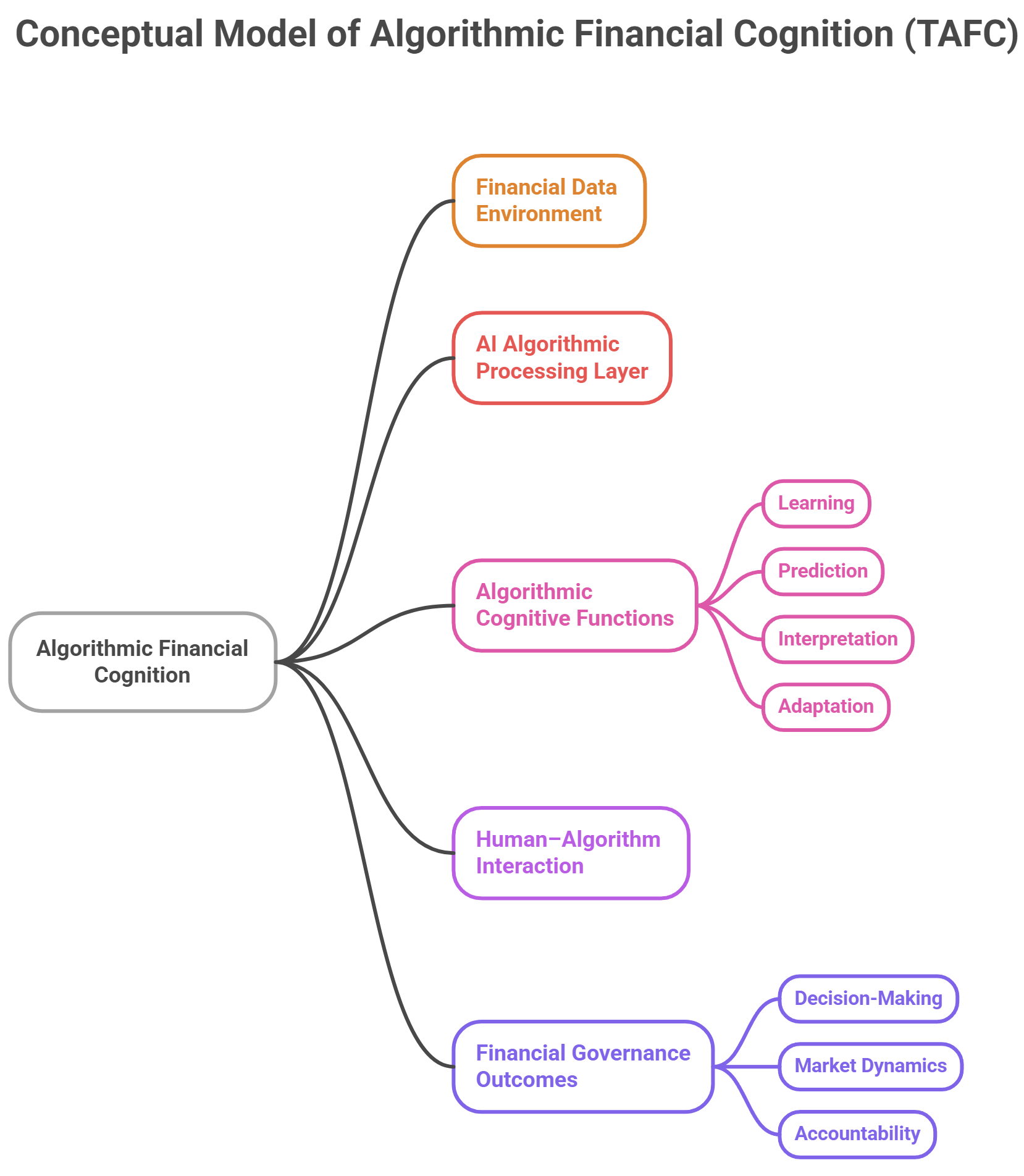
3.4 Conceptual Model of Algorithmic Financial Cognition
The TAFC conceptual model proposes that algorithmic financial cognition emerges through the interaction of five interconnected layers:
Layer 1: Data Environment
The foundation of algorithmic cognition consists of increasingly diverse financial data sources:
Market data,
Economic indicators,
Corporate information,
Alternative datasets,
Textual and behavioral signals.
Layer 2: Algorithmic Processing
AI systems transform data into cognitive outputs through:
Machine learning,
Deep learning,
Natural language processing,
Generative AI.
Layer 3: Cognitive Functions
Algorithms perform financial cognitive functions:
Recognition,
Interpretation,
Prediction,
Recommendation,
Adaptation.
Layer 4: Human–Algorithm Interaction
Financial actors interact with algorithmic systems through:
Decision support,
Strategic evaluation,
Oversight,
Intervention.
Layer 5: Financial Governance Outcomes
The interaction between humans and algorithms produces consequences for:
Investment decisions,
Market behavior,
Institutional strategies,
Regulatory governance.
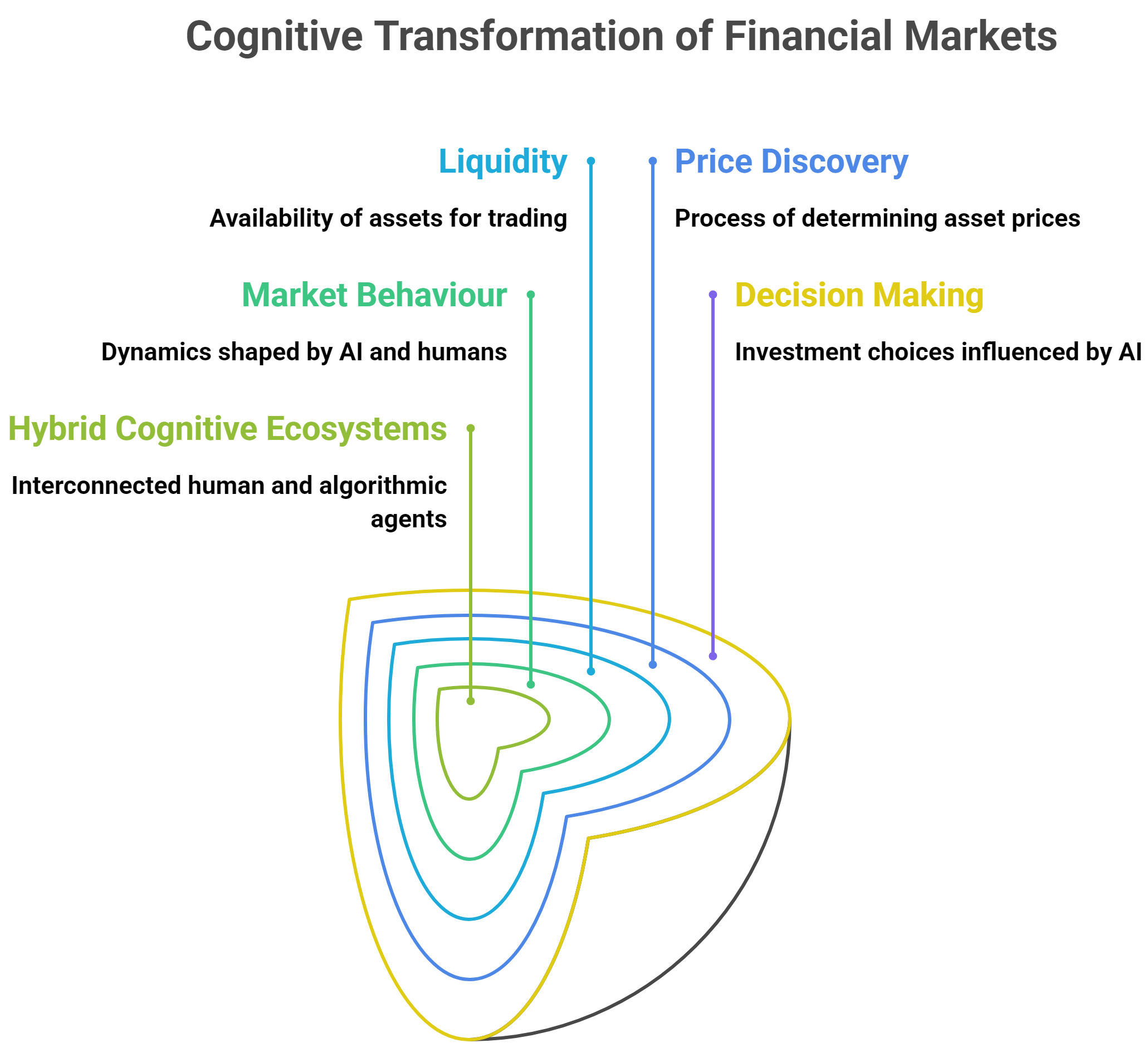
4. Cognitive Transformation of Financial Markets
The proposed TAFC says that AI has changed how financial markets think and operate. While earlier technologies mostly made markets faster or more efficient, AI is now changing how financial knowledge is created, understood, and used for economic decisions. As a result, financial markets are becoming places where both human expertise and AI work together to influence investment choices, pricing, liquidity, and governance (Gu et al. 2020).
Instead of seeing AI as just a set of separate tools, TAFC views today’s financial markets as places where thinking and decision-making are shared between people and AI systems. This change affects every part of the financial decision-making process, from gathering information to developing and implementing strategies. It also means we need to rethink old ideas about how markets work and are managed.
4.1 Knowledge Generation
In the past, financial markets relied on people to create and understand knowledge. Analysts would review company reports, economic data, industry studies, and market news to make investment decisions. This process was limited by the amount of information people could handle and by their expertise.
AI has changed this process significantly.
AI does more than just speed up information processing. It now helps create knowledge by finding connections, spotting hidden patterns, and producing analysis that guides financial decisions. Modern AI systems combine organized financial data with huge amounts of unstructured information, like earnings call transcripts, regulatory filings, satellite images, shipping records, social media opinions, patent databases, and global news, to build a detailed picture of financial reality.
Recent developments illustrate this transformation. BloombergGPT, developed by Bloomberg, was specifically trained on financial language and demonstrated significant improvements across financial natural language processing tasks, enabling automated interpretation of financial documents and domain-specific knowledge extraction (Wu et al., 2023). Likewise, Morgan Stanley's AI Assistant, built in collaboration with OpenAI, enables financial advisors to search, synthesize, and retrieve decades of institutional research in real time, fundamentally changing how financial knowledge is accessed and applied (Wu et al., 2023).
Large financial institutions have similarly expanded AI-driven research capabilities. JPMorgan Chase has integrated AI into investment research, fraud detection, regulatory compliance, and market intelligence, recognizing AI as a strategic capability rather than merely an operational technology (Wu et al., 2023).
These changes show that creating knowledge is now a team effort between people and AI. AI does more than just find information. it can spot patterns that people might miss because of the limits of human thinking.
Consequently, TAFC argues that financial knowledge has become algorithmically mediated. Knowledge is no longer produced exclusively by human interpretation but emerges through continuous interaction among data ecosystems, AI models, and institutional expertise.
4.2 Decision Making
Decision-making is one of the biggest ways that thinking in financial markets has changed.
In the past, financial decisions were made step by step by people. Analysts would review information, committees would weigh different options, and portfolio managers would make final choices based on their experience and judgment.
With AI, this process has become a mix of human and machine thinking.
Today, financial decisions are often made through teamwork between people and AI. AI systems can consider thousands of factors at once, identify complex connections, estimate probabilities, generate different investment scenarios, and continually update their advice as markets change.
Machine learning models now support numerous financial decisions, including:
Asset allocation,
Portfolio optimization,
Credit assessment,
Market forecasting,
Derivatives pricing,
Liquidity management,
Anti-money laundering surveillance.
For example, Blackrock’s Aladdin platform combines extensive data analytics, machine learning capabilities, and portfolio risk management tools to support investment decisions across institutions managing trillions of dollars in assets. Rather than replacing portfolio managers, such systems augment institutional decision-making by providing continuously updated analytical intelligence.
Similarly, Bridgewater Associates has increasingly invested in AI-enhanced research processes to improve macroeconomic analysis and systematic investment decision-making.
TAFC sees these changes as a sign that decision-making is being shared. Authority is no longer just in the hands of people or organizations but is now distributed between people and AI systems working together. It is important to note that AI does not run financial markets on its own. Instead, financial thinking now comes from people and AI working together, which is changing how decisions are made in organizations.
4.3 Price Discovery
Traditionally, price discovery was explained as buyers and sellers using available information to set market prices. Classic theories like the Efficient Market Hypothesis (Fama, 1970) hold that prices adjust slowly to reflect public information as market participants act rationally.
AI changes this process by altering how information enters the markets.
AI systems continuously analyze structured and unstructured information streams—including corporate filings, central bank communications, macroeconomic releases, satellite imagery, shipping activity, weather data, social media discussions, and geopolitical developments—allowing markets to incorporate information more rapidly than ever before.
Machine learning models can detect weak predictive signals across thousands of variables that would remain invisible under traditional statistical approaches (Gu, Kelly and Xiu, 2020).
As a result, price discovery now depends more on how algorithms interpret information, not just on human judgment.
This change brings up important questions for theory.
Prices now reflect not just economic basics, but also the ways different AI systems think and operate. This means that market prices are partly shaped by how various algorithms, each with its own strengths and data, interact.
TAFC describes this phenomenon as algorithmically mediated price discovery, in which prices emerge from interactions among distributed cognitive agents rather than exclusively from human information processing.
4.4 Liquidity
Traditionally, liquidity means how deep the market is, how much it costs to trade, and how easy it is to buy or sell assets.
Algorithmic trading has substantially increased liquidity across many financial markets by improving execution speed, narrowing bid–ask spreads, and facilitating continuous market participation (Hendershott et al., 2011).
Market makers such as Citadel Securities employ sophisticated algorithmic systems capable of processing enormous volumes of market information while continuously updating quotations across multiple asset classes.
But with AI, the link between how markets think and how liquid they are has become more complicated.
Machine learning systems are continually adapting to market changes. Usually, this helps make markets more efficient and improves liquidity.
However, when markets are uncertain, many algorithms might react to the same signals simultaneously. This can lead to similar actions that worsen liquidity problems.
The 2010 Flash Crash, although preceding modern generative AI, demonstrated how interactions among automated trading systems could contribute to rapid market instability (CFTC and SEC, 2010). More recent regulatory discussions by the Financial Stability Board (2024) and the Bank for International Settlements (2024) have emphasized that increasingly sophisticated AI systems could amplify concentration risk, model correlation, and systemic liquidity pressures.
TAFC says we should no longer see liquidity as just a technical market detail.
Now, liquidity is more about how different thinking systems, both human and AI, act together in the market.
4.5 Market Behavior
AI has changed how markets behave by changing how information is understood, how people form expectations, and how trading strategies develop.
Traditional behavioral finance explains market anomalies primarily through human cognitive biases such as overconfidence, herding, anchoring, and loss aversion (Kahneman and Tversky, 1979).
TAFC says that today’s markets show mixed behavior, with results driven by both human biases and the way AI systems learn.
AI systems do not have feelings or psychological biases. Still, they learn from past market actions, so they might accidentally repeat or even reinforce certain behaviors found in their training data.
For example, reinforcement learning systems continuously adjust trading behavior according to observed market feedback, potentially reinforcing momentum effects or correlated market responses.
Generative AI further transforms market behavior by accelerating the dissemination of information. AI-generated research summaries, earnings analyses, and market commentaries increase the speed at which market narratives develop, potentially shortening the time available for human interpretation.
So, how markets behave now depends more and more on the interactions between:
Human expectations,
Institutional incentives,
Algorithmic learning,
Continuous data feedback.
TAFC calls this a financial ecosystem created by both people and algorithms, where neither side fully controls what happens in the market.
4.6 Wealth Management
Wealth management is a clear example of how the industry is moving from simple automation to using AI for financial thinking. Early robot-advisors such as Betterment and Wealth front automated portfolio allocation using predefined optimization models and investor questionnaires (Morgan Stanley, 2023).
Today’s AI systems can do much more than this.
Financial institutions increasingly deploy generative AI to analyze clients' objectives, summarize market developments, interpret investment research, identify tax-optimization opportunities, and personalize financial recommendations.
Morgan Stanley's AI Assistant illustrates this evolution by enabling financial advisors to access institutional expertise in a conversational manner, thereby augmenting professional judgment rather than merely automating administrative tasks.
Similarly, UBS and other global wealth managers have expanded AI initiatives to improve client servicing, portfolio analytics, and operational efficiency through advanced machine learning and natural language processing (Morgan Stanley, 2023).
According to TAFC, these changes show the rise of cognitive wealth management, where advice comes from a mix of:
Human expertise,
Institutional knowledge,
Alien preferences,
Algorithmic reasoning,
Continuous learning.
Because of this, financial advisors are no longer just the main source of financial knowledge. Instead, they now guide, interpret, and oversee the intelligence produced by AI systems (Gu et al. 2020).
This change has big effects on how things are managed. As AI takes on more thinking roles in wealth management, companies need strict rules for transparency, accountability, clear explanations, and human oversight to keep trust and meet their responsibilities(Morgan Stanley, 2023).
5. Cognitive Risks in AI-Driven Finance
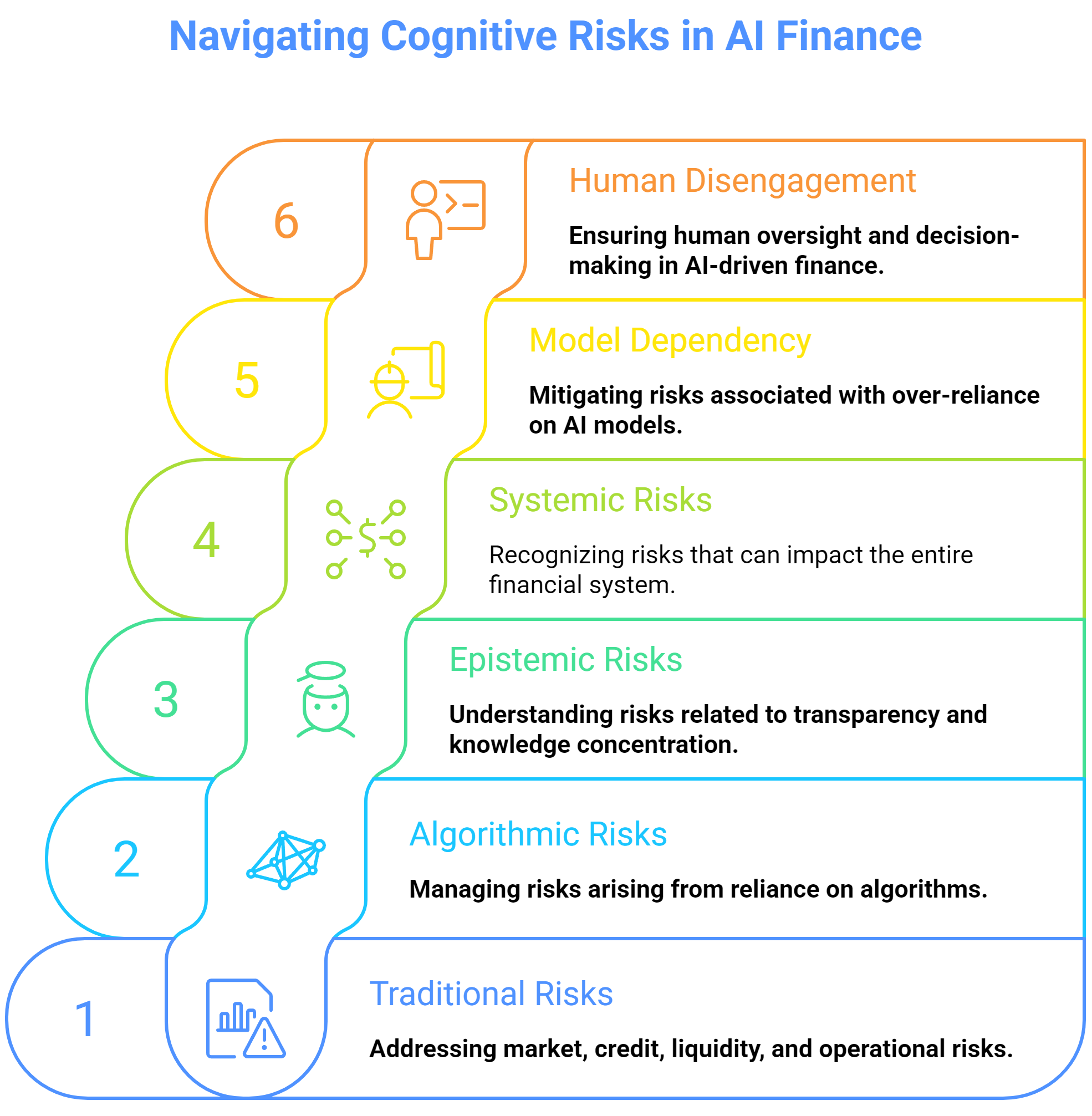
As AI becomes more common in finance, it introduces new risks that go beyond traditional financial and technical concerns. Standard risk frameworks still focus on market, credit, liquidity, and operational risks. These are still important, but they do not fully capture the risks associated with using AI in financial decision-making.
The proposed TAFC explains that as AI becomes central to financial thinking, the types of risks also change. Now, risks come not just from calculation errors or software problems, but also from relying on algorithms for thinking, the lack of transparency in machine learning, concentrating knowledge in a few systems, and changes in how people make decisions.
This section examines how traditional financial risks are different from new cognitive risks arising from the ways humans, AI, and finance interacts.
5.1 Traditional Risks
Financial institutions have historically managed risk through well-established frameworks that classify uncertainty into distinct categories. International regulatory standards, particularly the Basel Accords, recognize several core categories of financial risk, including market risk, credit risk, liquidity risk, and operational risk (Basel Committee on Banking Supervision, 2019).
Market risk arises from fluctuations in asset prices, interest rates, and exchange rates, as well as market volatility. Credit risk concerns the possibility that borrowers or counterparties fail to meet their contractual obligations. Liquidity risk reflects the inability to execute transactions without significantly affecting market prices, while operational risk encompasses failures arising from internal processes, human error, or technological malfunctions.
Traditional financial risk management is based on the idea that these risks stem from economic uncertainty and can be managed using tools such as statistical models, diversification, capital rules, stress tests, and regulations.
can help measure and track these risks, but it does not eliminate them. In fact, AI can make these risks spread more quickly and become more complicated in connected financial markets.
For example, AI-powered trading can lower costs when markets are stable, but it can also cause markets to react more quickly during stressful periods. Similarly, machine learning can improve the accuracy of credit checks, but it can also introduce new uncertainties that traditional risk management may overlook.
So, traditional financial risks still matter, but they are now closely linked with algorithmic systems that change how these risks look and behave.
5.2 Algorithmic Risks
Algorithmic risks arise from how AI systems are designed, how they operate, how they learn, and how they interact with one another, rather than from basic economic factors.
Modern AI systems, unlike traditional software, continue to learn from new data, so their behavior changes with different situations. This means we cannot always predict algorithmic risks using standard software checks.
There are several many types of algorithmic risk today.
First, model opacity limits financial institutions' ability to understand why complex AI models generate particular recommendations or predictions. Deep learning systems may achieve high predictive accuracy yet remain difficult to interpret, posing challenges for internal governance and regulatory oversight (Doshi-Velez and Kim, 2017).
Second, training-data bias can systematically distort financial decisions. AI systems trained on incomplete, unrepresentative, or historically biased datasets may unintentionally reinforce existing inequalities or generate inaccurate assessments of borrowers, investment opportunities, or market conditions.
Third, algorithmic correlation may amplify systemic behavior. Financial institutions frequently adopt similar machine learning architectures, optimization methods, and commercial AI platforms. During periods of market stress, these systems may respond similarly to common signals, increasing synchronized trading behavior and reducing market resilience.
The Financial Stability Board (2024) has identified model concentration, third-party dependency, and common technology providers as emerging vulnerabilities within AI-enabled financial systems. Likewise, the Bank for International Settlements (2024) has emphasized that AI may introduce new channels of contagion through highly interconnected algorithmic infrastructures.
TAFC sees these risks as proof that AI is now more than just a tool. It actively shapes financial thinking, and how it works can directly affect financial stability.
5.3 Epistemic Risks
One major result of Algorithmic Financial Cognition is the increase in epistemic risks. These risks relate to how financial knowledge is created, understood, checked, and managed.
The concept of epistemic risk originates in philosophy of knowledge and scientific reasoning, where it refers to the possibility that individuals or institutions develop beliefs, decisions, or policies based on incomplete, distorted, or unreliable knowledge (Bishop and Trout, 2005. Biddle and Kukla, 2017). Within risk management, epistemic uncertainty has long been distinguished from aleatory uncertainty because it arises from limitations in knowledge rather than inherent randomness.
TAFC uses this idea to explain how financial systems are managed. Epistemic risks arise when algorithmic systems increasingly determine which information is important, how market signals are interpreted, and which investment stories become most influential.
Unlike regular information gaps, epistemic risks are about the quality of financial thinking itself.
Several factors add to these risks.
First, AI systems may identify statistically significant relationships that lack genuine economic causality. Machine learning models optimize predictive performance rather than causal understanding. Consequently, investment strategies may rely upon correlations that perform well historically but fail under structural market changes.
Second, generative AI systems may produce plausible but inaccurate financial analyses if their outputs are accepted without adequate human verification. Although retrieval-augmented generation and domain-specific language models substantially improve factual reliability, no contemporary generative AI system completely eliminates the possibility of erroneous or fabricated outputs.
Third, increasing dependence on common data sources may narrow epistemic diversity within financial markets. If numerous institutions rely upon similar AI models trained on similar datasets, market participants may converge toward homogeneous interpretations of financial reality. Such convergence may reduce institutional diversity and increase collective vulnerability to unforeseen events.
Fourth, epistemic risks may emerge from excessive confidence in algorithmic outputs. Numerous studies in human-computer interaction have demonstrated the phenomenon of automation bias, whereby human decision-makers increasingly defer to automated recommendations even when those recommendations are incorrect (Parasuraman and Riley, 1997. Lyell and Coie says epistemic risks are central to AI-driven finance because they affect both how financial knowledge is created and how decisions are made.
So, financial governance should focus not just on how accurate AI systems are, but also on the main principles behind how algorithmic knowledge is created, checked, and used.
5.4 Systemic Risks
Systemic risk has traditionally been understood as the possibility that failures within individual financial institutions or market segments propagate throughout the broader financial system, threatening financial stability (Financial Stability Board, 2025).
AI brings new ways for systemic risks to develop.
First, AI increases the speed of information transmission across markets. Machine learning systems continuously monitor identical macroeconomic releases, central bank announcements, and financial news, enabling synchronized market reactions within milliseconds.
Second, the growing concentration of AI capabilities among a relatively small number of cloud providers, model developers, and data infrastructure companies creates new forms of systemic dependency. The Financial Stability Board (2024) has identified third-party technology concentration as an emerging financial stability concern.
Third, adaptive AI systems may generate feedback loops that reinforce market movements. Reinforcement learning agents responding to similar market conditions may unintentionally amplify volatility by continuously adjusting their strategies based on identical observations.
Traditional systemic risks often come from balance-sheet problems, but AI-related systemic risks now come more from shared ways of thinking built into algorithms.
TAFC suggests we should see systemic risk not just in financial connections, but also in how algorithms think and interact.
5.5 Model Dependency
As financial institutions use AI more, depending on algorithmic models becomes a major challenge for management.
Model dependency happens when organizations rely too much on AI systems for analysis, risk assessment, or important decisions. In the past, financial institutions used quantitative models but kept strong human oversight. Now, modern AI systems influence many areas at the same time, such as investment research, compliance, portfolio management, customer advice, fraud detection, and daily decision-making.
This brings several challenges for management.
First, organizational expertise may gradually migrate from human professionals toward algorithmic systems.
Second, institutions may lose the internal capacity to independently validate increasingly complex AI outputs.
Third, dependence upon externally developed foundation models or cloud-based AI services introduces strategic vulnerabilities related to vendor concentration, service continuity, cybersecurity, and regulatory compliance.
Recent reports from the Bank for International Settlements (2024) and the International Monetary Fund (2024) emphasize that financial institution should strengthen model governance frameworks, validation procedures, and independent oversight to reduce excessive dependence on AI systems.
TAFC sees model dependency as a shift from relying on technology to relying on algorithms for knowledge, making organizations more dependent on these systems for what they know.
5.6 Human Disengagement
One of the most serious cognitive risks TAFC points out is human disengagement.
Human disengagement means people play a smaller role in financial decision-making as AI systems handle increasingly complex analysis.
This is different from simply automating routine tasks.
Instead, it means giving higher-level thinking, such as interpretation, judgment, idea creation, and strategic reasoning, to intelligent systems.
Studies on automation show that overreliance on technology can reduce alertness, awareness, and critical thinking (Parasuraman, Sheridan, and Wickens, 2000). In finance, this matters even more because AI now helps make major decisions that affect investments, stability, and compliance.
Human disengagement can develop in several ways.
First, decision-makers may become overly dependent on AI-generated recommendations, reducing independent analytical verification.
Second, younger professionals entering AI-enabled organizations may have fewer opportunities to cultivate deep financial judgment because many analytical functions are already performed algorithmically (Aldasoro et al., 2024).
Third, learning within organizations may shift from groups to private AI systems, making knowledge less clear and harder to share.
TAFC believes the real long-term issue is not whether AI will replace people, but whether financial institutions can keep humans in control of important thinking as decisions become more driven by algorithms.
Good financial management should not just aim for more automation, but also focus on balancing human expertise with AI. Maintaining human oversight, encouraging critical thinking, and ensuring organizations can question AI results are all important for strong financial governance today.
6. Financial Governance in the Cognitive Age
AI is changing the basic ideas behind modern financial regulation. Current rules were made for systems where people created financial knowledge, made decisions, and held legal responsibility (Aldasoro et al. 2024). Even when advanced models were used, humans and their organizations still had the final say in financial decisions.
The proposed Theory of Algorithmic Financial Cognition (TAFC) says that this structure is changing. AI systems now help create financial knowledge, interpret market signals, and make strategic suggestions. As a result, financial governance needs to move from just regulating activities to also overseeing the creation of financial knowledge.
This change does not mean we should get rid of current regulations or laws. Instead, we need to update our rules to recognize that thinking and decision-making are now shared between people and AI systems. The main challenge for regulators over the next decade will be managing how human and AI systems work together in finance.
6.1 Why Traditional Regulation Is No Longer Sufficient
Traditional financial regulation has historically focused on four principal objectives:
Maintaining financial stability.
Protecting investors and consumers.
Ensuring market integrity.
Preserving institutional solvency.
International regulatory frameworks—including the Basel Accords, IOSCO principles, and post-2008 financial reforms—were designed to address risks associated with leverage, capital adequacy, liquidity, market abuse, operational resilience, and systemic interconnectedness.
These frameworks implicitly assume that financial institutions remain the primary centers of cognition. Regulations supervise decisions made by boards of directors, executive management, portfolio managers, traders, and risk committees. Accountability is therefore assigned to identifiable human actors operating within legally recognized organizations.
AI fundamentally alters these assumptions.
More and more, financial decisions rely on algorithms that process information, make suggestions, adapt to changes, and shape how institutions act. People often review the results from these systems, even though it is not always clear how the algorithms reached their conclusions.
As a result, traditional regulations face three main problems.
First, current regulations focus on the results of financial activities, but AI now shapes the thinking that leads to those results.
Second, traditional rules expect decision-making structures to stay the same, but machine learning systems keep changing even after they are put in place.
Third, regulations still focus on institutions, even though these institutions now rely more on outside providers for cloud services, AI models, and data.
Recent international initiatives recognize these challenges. The European Union AI Act (AI Act) introduces a risk-based regulatory framework for AI systems, classifying applications according to their potential societal impact and imposing governance obligations for high-risk systems (European Union, 2024). Although the AI Act is not financial legislation per se, many AI applications used in credit assessment, insurance, fraud detection, and investment services may fall within its regulatory scope.
Similarly, the Financial Stability Board (2024) and the Bank for International Settlements (2024) have emphasized that AI requires supervisory approaches extending beyond traditional prudential regulation because algorithmic concentration, model opacity, and third-party dependencies introduce novel sources of financial vulnerability.
According to TAFC, these changes mean that financial regulation should move from just supervising institutions to also supervising how these institutions think and make decisions.
6.2 Supervising Cognitive Systems
TAFC suggests that future financial supervision should focus more on how knowledge is created and used, rather than solely on organizations or technology.
A cognitive system comprises the integrated network through which financial knowledge is generated, interpreted, validated, and transformed into organizational decisions. In AI-enabled financial institutions, this network includes:
Human decision-makers.
Machine learning models.
Foundation models and large language models.
Internal and external data infrastructures.
Automated workflows.
Governance mechanisms.
Traditional supervision focuses on results such as capital, liquidity, and compliance. Cognitive supervision goes further by checking how financial institutions create knowledge before making decisions.
Such supervision should therefore assess:
Data quality and governance.
Model development processes.
Validation methodologies.
Retraining procedures.
Human intervention mechanisms.
Institutional capacity to challenge algorithmic recommendations.
The goal is not just to regulate algorithms, but to assess the strength and reliability of the entire system that supports financial decisions.
This approach aligns with recent discussions among regulators about managing risks from AI models, including guidance on model governance, independent checks, and ensuring systems can keep working under stress.
TAFC proposes that cognitive supervision should become a distinct dimension of future financial regulation.
6.3 Explainability
Explainability is a major challenge in AI governance because advanced machine learning often gives accurate results without showing how those results were reached. In finance, explainability matters greatly because algorithmic recommendations now influence decisions about credit, investments, fraud, money laundering, insurance, and risk (NIST 2024).
Traditional financial regulation assumes that institutions can justify significant decisions through documented reasoning and transparent internal procedures.
But advanced AI systems make this assumption harder to maintain.
Deep neural networks, transformer architectures, and ensemble learning methods often function as complex statistical systems whose internal representations cannot easily be translated into human-understandable explanations (Doshi-Velez and Kim, 2017).
TAFC distinguishes between technical explainability and cognitive explainability.
Technical explainability concerns understanding how algorithms generate outputs.
Cognitive explainability concerns understanding how algorithmic reasoning influences institutional judgment, governance processes, and strategic decision-making.
This difference matters because financial governance needs more than just technical transparency. Regulators, boards, investors, and customers need to know how algorithmic results shape important decisions.
So, explainability should be seen not just as a technical goal, but as a key part of governance that helps keep institutions trusted and regulators confident.
6.4 Accountability
Accountability has long served as a foundational principle of financial governance.
Corporate governance frameworks assign responsibility to boards, executive management, investment committees, auditors, and regulators. These structures assume that human actors possess both decision authority and responsibility for organizational outcomes.
AI makes accountability more complicated.
When AI systems strongly influence investment advice, risk assessment, or trading strategies, it becomes increasingly difficult to determine who is ultimately accountable. Multiple actors may simultaneously contribute to a single financial outcome, including:
Financial institutions.
Software developers.
Foundation model providers.
Cloud service providers.
Data vendors.
Model validators.
Human supervisors.
The real challenge is not whether AI should be legally responsible, but how to share accountability among all the organizations involved in these connected systems.
The OECD AI Principles (updated 2024) emphasize that organizations deploying AI remain responsible for ensuring appropriate human oversight, transparency, and governance throughout the AI lifecycle.
Similarly, the NIST AI Risk Management Framework (2024 update) emphasizes that accountability should be embedded in governance structures, documentation, continuous monitoring, and organizational responsibility, rather than delegated to technological systems themselves.
TAFC suggests a model called distributed cognitive accountability, where responsibility stays with people and institutions but also includes oversight of how algorithms think and act.
This view avoids two extremes: it does not treat AI as a legal person, nor does it assume that current accountability rules are sufficient.
6.5 Human Oversight
Of all governance principles, meaningful human oversight is the most important safeguard in financial systems that use AI.
Human oversight is more than just having someone approve what the algorithm produces. Requires institutions to maintain the cognitive capacity necessary to evaluate, question, and, where appropriate, override AI-generated recommendations.
The European Union AI Act emphasizes human oversight as a core requirement for high-risk AI systems, specifying that oversight should enable natural persons to understand system capabilities, identify anomalies, and intervene effectively when necessary (European Union, 2024).
Within financial institutions, meaningful oversight includes several complementary dimensions:
Strategic oversight, ensuring that AI systems remain aligned with institutional objectives and fiduciary obligations.
Operational oversight, monitoring system performance, model drift, and unexpected behavior.
Ethical oversight, ensuring fairness, transparency, and responsible treatment of customers.
Regulatory oversight, maintaining compliance with applicable financial regulations and AI governance requirements.
TAFC says the main goal of human oversight is to keep people in charge of important thinking, not just to increase human involvement.
Relying too much on algorithms can lead to automation bias and less engagement from people. On the other hand, excessive human involvement can undermine many of the benefits of using adaptive AI.
Good governance needs the right balance between what algorithms can do and human judgment.
6.6 Global Coordination
AI systems naturally transcend national borders. They may be developed in one jurisdiction, trained on globally sourced data, deployed through multinational cloud infrastructures, and utilized by financial institutions operating across multiple regulatory environments (European Union, 2024; IOSCO, 2021). As a result, if each country handles AI governance differently, it can lead to inconsistent rules, gaps in supervision, and uncertainty for organizations.
This is why working together internationally has become more important.
Several organizations have already begun developing complementary governance frameworks, including:
The Financial Stability Board (FSB), addressing financial stability implications of AI.
The Bank for International Settlements (BIS), examining AI, digital finance, and prudential supervision.
The Organization for Economic Co-operation and Development (OECD), establishing internationally recognized AI Principles.
The International Organization of Securities Commissions (IOSCO), providing guidance on AI-related market conduct and investor protection.
The International Monetary Fund (IMF) is analyzing the macro-financial implications of generative AI.
While these efforts are a big step forward, they mostly focus on specific sectors.
TAFC argues that future governance should move toward an integrated framework of Global Cognitive Financial Governance (GCFG) built upon five complementary pillars:
International standards for AI governance in financial services, ensuring interoperability while respecting domestic regulatory mandates.
Cross-border supervision of critical AI infrastructures, particularly where financial institutions rely on common foundation models, cloud providers, or data ecosystems.
Shared principles for cognitive accountability, clarifying responsibilities across financial institutions, technology developers, and infrastructure providers.
Global mechanisms for algorithmic incident reporting, enabling regulators to exchange information on significant AI-related failures, model vulnerabilities, and systemic events.
Continuous international cooperation on AI model evaluation, promoting common methodologies for validation, stress testing, benchmarking, and governance of advanced financial AI systems.
Instead of calling for a single global regulator, TAFC envisions a coordinated international system in which each country retains its own authority while adhering to shared principles for overseeing the use of algorithms in finance.
As financial intelligence spreads across connected AI systems, governance needs to keep up. The main challenge now is not just regulating financial institutions, but making sure the algorithms that shape financial knowledge stay transparent, accountable, strong, and under real human and institutional control.
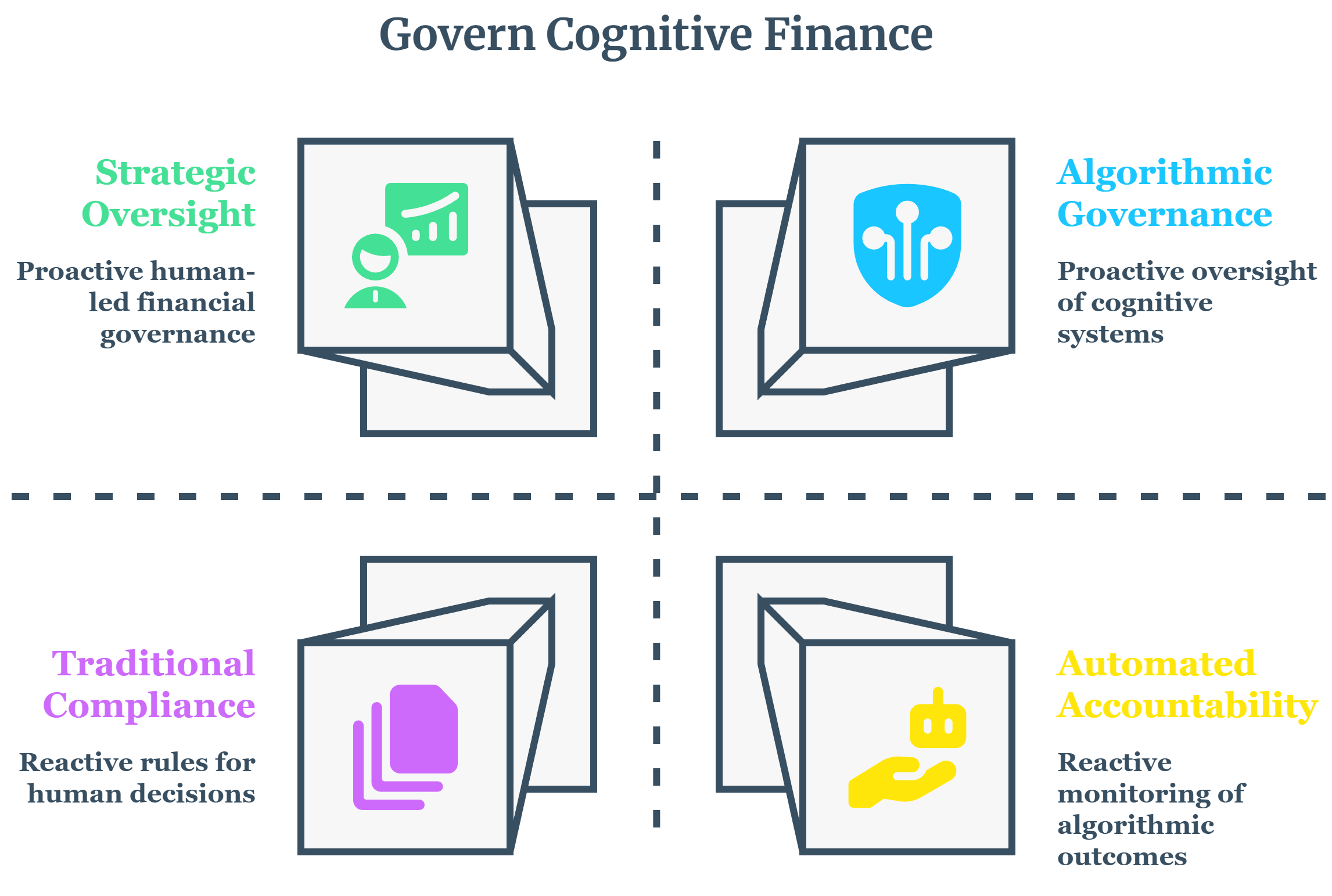
7. Policy Framework for Financial Governance in the Age of Algorithmic Financial Cognition
The proposed TAFC significantly impacts financial policy and institutional governance. As AI becomes integral to financial markets, policy frameworks must move beyond regulating technology to governing the production, validation, and use of algorithmic financial knowledge.
Traditional financial regulation has focused on prudential supervision, market conduct, consumer protection, and systemic resilience. While these remain essential, they do not fully address the governance challenges of adaptive AI systems that generate financial knowledge, influence investment decisions, and reshape market behavior.
This section presents a multi-level policy framework based on the principle that governance in the cognitive age must preserve financial resilience, institutional accountability, cognitive transparency, and meaningful human authority.
7.1 Policy Recommendations for Financial Regulators
Financial regulators remain the primary institutions responsible for maintaining market integrity and protecting investors. However, supervisory approaches designed for conventional financial systems require significant adaptation to address AI-enabled financial cognition.
TAFC proposes five policy priorities:
Expand Regulatory Scope from Financial Activities to Cognitive Processes
Supervisory authorities should evaluate not only the outcomes of AI-assisted financial decisions but also the processes through which algorithmic knowledge is generated, validated, and incorporated into organizational decision-making.
Regulatory examinations should therefore include:
AI governance structures.
Model validation procedures.
Data governance frameworks.
Human oversight mechanisms.
Documentation of algorithmic decision processes.
Establish AI Model Governance Standards
Financial institutions should be required to maintain comprehensive governance frameworks covering the complete AI lifecycle, including:
Model development.
Training data quality.
Independent validation.
Deployment approval.
Continuous monitoring.
Retirement procedures.
These requirements should complement existing model risk management practices rather than replace them.
Require Algorithmic Auditability
Regulators should encourage the development of audit mechanisms capable of evaluating AI systems throughout their operational lifecycle.
Audit requirements should include:
Model version control.
Data provenance.
Performance monitoring.
Documentation of material model updates.
Governance responsibilities.
Algorithmic audits should become as routine as financial audits for high-impact AI systems.
Introduce Cognitive Stress Testing
Traditional stress testing evaluates institutional resilience under adverse financial scenarios.
TAFC proposes extending stress testing toward cognitive stress testing, examining how AI systems respond to:
Unexpected market conditions.
Distributional shifts.
Adversarial data.
Conflicting information.
Degraded data quality.
Model drift.
Such assessments would strengthen organizational resilience before cognitive failures become systemic events.
Develop Regulatory AI Expertise
Effective supervision requires regulators to possess sufficient technical and organizational expertise to evaluate increasingly sophisticated AI systems.
Regulatory agencies should therefore invest in:
AI specialists.
Interdisciplinary supervisory teams.
Computational infrastructure.
Continuous professional development.
Without institutional cognitive capacity, effective AI supervision will remain difficult.
7.2 Policy Recommendations for Central Banks
Central banks occupy a unique position because they simultaneously supervise financial institutions, safeguard monetary stability, and monitor systemic risk.
AI introduces several new responsibilities.
Monitoring AI-Driven Systemic Risk
Central banks should incorporate AI-related indicators into macro prudential surveillance, including:
Concentration of AI service providers.
Dependence on foundation models.
Cloud infrastructure concentration.
Correlated algorithmic behavior.
AI-related operational disruptions.
Developing AI-Based Supervisory Analytics
Supervisory authorities themselves should responsibly deploy AI to improve:
Macro prudential monitoring.
Systemic risk detection.
Financial stability analysis.
Fraud identification.
Regulatory reporting.
However, supervisory AI should remain subject to governance standards equivalent to those expected of supervised institutions.
Strengthening Financial Infrastructure Resilience
Central banks should collaborate with financial market infrastructures to ensure that critical payment and settlement systems, as well as financial market utilities, remain resilient to AI-related operational disruptions and cyber threats.
Supporting Responsible Financial Innovation
Rather than restricting innovation, central banks should promote controlled experimentation through:
Regulatory sandboxes.
Innovation hubs.
Supervised pilot projects.
Collaborative research initiatives.
Such mechanisms allow innovation while maintaining financial stability.
7.3 Policy Recommendations for Financial Institutions
Financial institutions represent the primary operational environment in which algorithmic financial cognition develops.
Consequently, governance responsibilities should extend beyond technical implementation toward organizational transformation.
Establish Board-Level AI Governance
Boards of directors should formally oversee AI strategy to ensure alignment with institutional objectives, regulatory requirements, and fiduciary responsibilities.
Board oversight should include regular reporting on:
AI deployment.
Model performance.
Governance incidents.
Emerging risks.
Regulatory developments.
Develop Enterprise Cognitive Governance Frameworks
Institutions should establish integrated governance covering:
Data governance.
AI governance.
Model risk management.
Cybersecurity.
Operational resilience.
Ethical oversight.
These components should operate as an integrated governance ecosystem, not as isolated compliance functions.
Maintain Human Cognitive Capacity
Financial institutions should maintain independent analytical capabilities to challenge AI-generated recommendations.
Training programs should strengthen:
Critical thinking.
Quantitative reasoning.
AI literacy.
Governance competencies.
Human expertise is essential for effective oversight.
Promote Cross-Functional AI Governance
Effective governance requires collaboration among:
Risk management.
Compliance.
Information technology.
Legal departments.
Internal audit.
Business leadership.
AI governance should be an enterprise-wide responsibility, not solely a technological function.
7.4 Policy Recommendations for Asset Managers
Asset managers increasingly rely upon AI across portfolio construction, market analysis, client services, and investment research.
Given their influence on capital allocation, additional governance measures are warranted.
Ensure Transparent AI-Assisted Investment Processes
Investment organizations should clearly document:
AI-supported investment strategies.
Model objectives.
Validation methodologies.
Human approval procedures.
Transparency strengthens fiduciary responsibility and investor confidence.
Prevent Excessive Model Concentration
Asset managers should avoid excessive dependence on identical commercial AI systems.
Maintaining diversity in:
Data sources.
Analytical methodologies.
Model architectures.
Investment approaches,
Reduces correlated investment behavior and strengthens market resilience.
Strengthen Fiduciary AI Governance
AI deployment should remain consistent with fiduciary obligations owed to investors.
Institutions should ensure that AI systems support:
Client interests.
Fairness.
Transparency.
Long-term value creation.
Algorithmic efficiency should never override fiduciary responsibility.
Continuous Model Validation
Investment models should undergo regular validation as market conditions change.
Performance metrics should evaluate not only predictive accuracy but also:
Robustness.
Explainability.
Stability.
Governance compliance.
7.5 Policy Recommendations for International Organizations
AI transcends national jurisdictions.
Financial governance therefore requires substantial international coordination.
Organizations including the Financial Stability Board (FSB), the Bank for International Settlements (BIS), the International Monetary Fund (IMF), the Organization for Economic Co-operation and Development (OECD), the International Organization of Securities Commissions (IOSCO), and the Basel Committee on Banking Supervision (BCBS) are well positioned to facilitate global cooperation.
TAFC proposes five strategic priorities.
Develop International Principles for Cognitive Financial Governance
Existing AI principles should be extended to explicitly address:
Algorithmic cognition.
Financial knowledge production.
AI-enabled governance.
Cognitive accountability.
Promote International Regulatory Interoperability
National AI regulations should remain compatible across jurisdictions to reduce regulatory fragmentation affecting multinational financial institutions (European Union AI Act, 2024. IOSCO, 2021).
Coordinate AI Incident Reporting
International organizations should facilitate secure mechanisms through which regulators exchange information regarding:
AI failures.
Governance incidents.
Systemic vulnerabilities.
Emerging technological risks.
Such cooperation would improve collective learning and crisis preparedness.
Develop Global Benchmarking Standards
International benchmarking frameworks should evaluate AI systems according to common governance criteria, including:
Robustness.
Explainability.
Accountability.
Resilience.
Fairness.
Operational reliability.
This would improve regulatory consistency while supporting innovation.
Support Capacity Building
Many developing economies face significant shortages of AI expertise within financial supervision.
International organizations should therefore expand technical assistance programs covering:
Supervisory training.
AI governance.
Model risk management.
Digital financial infrastructure.
Regulatory technology (RegTech).
Such initiatives would reduce global governance disparities while supporting the responsible adoption of AI.
Integrating the Policy Framework with TAFC
The policy recommendations presented in this chapter collectively operationalize the proposed TAFC.
Rather than regulating AI solely as a technological innovation, TAFC advocates governance that recognizes AI as an increasingly influential participant in financial cognition. Accordingly, future policy should protect not only market stability and institutional resilience but also the integrity, diversity, transparency, and accountability of financial knowledge itself.
The proposed framework rests on five foundational governance objectives:
Preserve meaningful human cognitive authority within AI-enabled financial systems.
Strengthen institutional governance over algorithmic knowledge production.
Enhance transparency and accountability throughout the AI lifecycle.
Reduce systemic vulnerabilities arising from cognitive concentration and model dependency.
Promote international cooperation to ensure that the governance of algorithmic financial cognition evolves consistently across global financial markets.
By shifting attention from technology governance alone to cognitive governance, this policy framework provides a practical pathway for translating TAFC into supervisory practice and public policy.
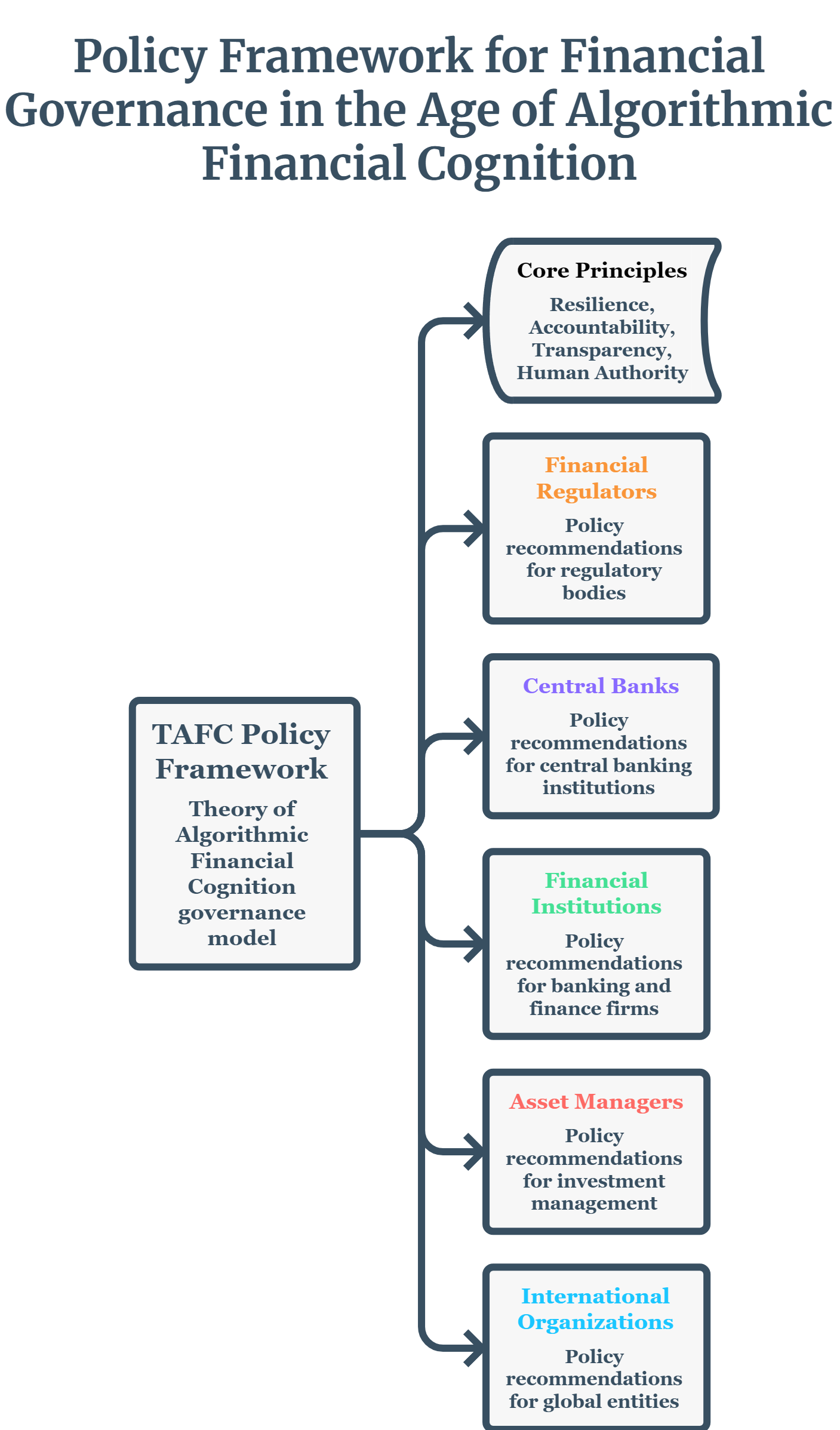
8. Future Research Agenda
The TAFC is proposed as a foundational theoretical framework rather than a closed conceptual model. Like other influential theories in finance and management, its long-term value depends upon its ability to generate cumulative empirical research, stimulate interdisciplinary inquiry, and provide testable explanations for emerging phenomena.
Accordingly, this section outlines a research agenda designed to transform TAFC from a conceptual contribution into a sustainable scientific program. The agenda identifies key research priorities, proposes empirically testable hypotheses, and suggests methodological approaches through which future studies may evaluate, refine, or extend the theory.
The proposed agenda is organized around three complementary dimensions:
Expanding theoretical understanding of algorithmic financial cognition.
Empirically testing the mechanisms proposed by TAFC.
Developing practical governance frameworks for AI-enabled financial systems.
8.1 Future Research Directions
8.1.1 Measuring Algorithmic Financial Cognition
One of the first priorities is developing reliable methods for measuring algorithmic financial cognition.
Current financial research includes numerous indicators of AI adoption, such as AI investment, automation levels, and machine learning utilization. However, there is currently no validated framework for measuring the extent to which financial cognition itself has become algorithmically distributed.
Future research should therefore develop multidimensional indicators that capture the cognitive characteristics of AI-enabled financial organizations.
Potential dimensions include:
Degree of cognitive delegation.
Reliance on AI-generated knowledge.
Organizational dependence on algorithmic decision support.
Integration of AI into strategic planning.
Human–AI interaction intensity.
Institutional cognitive diversity.
Developing standardized measurement scales would enable comparative studies across financial institutions, markets, and jurisdictions.
8.1.2 Human–Algorithm Cognitive Interaction
Although substantial research has examined automation and decision support, relatively little is known about the evolving relationship between human expertise and algorithmic cognition within financial institutions.
Future studies should investigate questions such as:
Under what conditions do financial professionals trust AI-generated recommendations?
When do experts override algorithmic advice?
How does organizational experience influence reliance on AI?
Which governance mechanisms improve the quality of collaborative decision-making?
Behavioral experiments involving investment professionals, portfolio managers, risk officers, and financial analysts could significantly improve understanding of cognitive interaction within hybrid decision environments.
8.1.3 Cognitive Diversity and Market Efficiency
One of the most important theoretical implications of TAFC concerns cognitive diversity.
Financial markets have traditionally benefited from heterogeneous beliefs, diverse analytical methods, and independent investment strategies.
Increasing reliance upon similar foundation models, common datasets, and standardized AI architectures raises an important question:
Does algorithmic convergence reduce cognitive diversity within financial markets?
Future research should examine whether increased AI standardization contributes to:
Correlated investment decisions.
Synchronized market behavior.
Reduced informational diversity.
Increased systemic fragility.
This research would extend both Behavioral Finance and Adaptive Markets Theory by incorporating algorithmic cognition into explanations of market efficiency.
8.1.4 AI and Institutional Learning
Another promising research direction concerns organizational learning.
Traditional organizational learning theories emphasize experience, knowledge sharing, and institutional memory.
AI increasingly participates in each of these processes.
Future studies should investigate:
How organizations learn through AI systems.
How institutional knowledge evolves alongside adaptive algorithms.
Whether AI strengthens or weakens organizational learning capabilities.
How cognitive authority changes during digital transformation.
This line of inquiry connects TAFC with organizational theory, knowledge management, and strategic management research.
8.1.5 Cross-Country Comparative Studies
AI is being adopted under highly diverse regulatory, institutional, and cultural conditions.
Comparative research should examine how different governance environments influence algorithmic financial cognition.
Possible comparisons include:
United States versus European Union.
Advanced economies versus emerging markets.
Bank-centered versus market-centered financial systems.
Public versus private financial institutions.
Such studies would contribute to understanding whether TAFC operates universally or whether institutional context significantly moderates algorithmic cognition.
8.2 Testable Research Hypotheses
For TAFC to develop into a cumulative scientific theory, its propositions must be translated into empirically testable hypotheses.
The following hypotheses represent an initial research agenda rather than an exhaustive list.
Hypothesis 1 (H1): Cognitive Delegation
Financial institutions that exhibit higher levels of AI-enabled cognitive delegation will make strategic decisions faster than institutions that rely primarily on traditional human-centered decision processes.
Possible empirical measures:
AI utilization indices.
Investment decision cycle duration.
Organizational responsiveness.
Hypothesis 2 (H2): Algorithmic Cognition and Investment Performance
The degree of algorithmic financial cognition is positively associated with investment performance, controlling for organizational size, market conditions, and portfolio characteristics.
Potential dependent variables include:
Risk-adjusted returns.
Forecasting accuracy.
Portfolio efficiency.
Hypothesis 3 (H3): Cognitive Opacity
Greater cognitive opacity of AI systems is associated with lower managerial trust and reduced governance effectiveness.
Potential variables include:
Explainability scores.
Managerial confidence.
Governance quality indicators.
Hypothesis 4 (H4): Model Dependency
Higher organizational dependence on AI models increases vulnerability to common-model failures and correlated financial risks.
Possible empirical settings:
Quantitative investment firms.
Commercial banks.
Insurance companies.
Hypothesis 5 (H5): Human Oversight
Meaningful human oversight moderates the relationship between AI adoption and organizational resilience, reducing the negative effects of algorithmic failures.
Potential indicators:
Governance maturity.
Human intervention frequency.
Operational resilience.
Hypothesis 6 (H6): Cognitive Diversity
Greater diversity of AI models and data sources within financial institutions is positively associated with organizational resilience and negatively associated with correlated investment behavior.
This hypothesis directly extends TAFC’s argument regarding cognitive concentration.
8.3 Operationalizing TAFC for Empirical Research
The transition from conceptual theory to empirical science requires operational definitions capable of quantitative measurement.
TAFC can be operationalized through five latent constructs.
Construct 1: Algorithmic Financial Cognition
Possible indicators:
AI-supported strategic decisions.
AI-generated investment analysis.
AI participation in risk assessment.
AI-assisted knowledge generation.
Construct 2: Cognitive Delegation
Indicators:
Percentage of AI-supported decisions.
AI autonomy levels.
Organizational reliance on algorithmic recommendations.
Construct 3: Cognitive Governance
Indicators:
AI governance maturity.
Board oversight.
Model validation procedures.
Governance transparency.
Construct 4: Cognitive Opacity
Indicators:
Explainability.
Interpretability.
Documentation quality.
User understanding.
Construct 5: Human Cognitive Authority
Indicators:
Override frequency.
Independent review mechanisms.
Decision accountability.
Organizational expertise.
These constructs could be measured using structured surveys, organizational assessments, governance audits, or hybrid quantitative indices.
8.4 Suggested Research Methodologies
TAFC is compatible with multiple methodological traditions.
Quantitative Research
Future studies may employ:
Structural equation modeling (SEM).
Partial least squares structural equation modeling (PLS-SEM).
Panel data regression.
Event studies.
Machine learning explainability metrics.
These approaches are appropriate for testing the relationships proposed by the theory.
Qualitative Research
Qualitative approaches remain equally valuable.
Researchers may conduct:
Executive interviews.
Case studies.
Comparative institutional analyses.
Regulatory document analysis.
Organizational ethnography.
These methods are particularly suitable for exploring cognitive governance processes that remain insufficiently understood.
Mixed Methods
A mixed-methods strategy may provide the strongest empirical validation.
For example:
Qualitative interviews identify dimensions of cognitive governance.
Survey instruments operationalize those dimensions.
Quantitative analysis tests theoretical relationships across institutions.
This sequential design enables both theoretical refinement and statistical validation.
8.5 Toward a New Research Program
The proposed Theory of Algorithmic Financial Cognition (TAFC) should be viewed not as a final explanation of AI-driven finance but as the beginning of a broader interdisciplinary research program.
Future research should integrate insights from:
Finance.
Artificial intelligence.
Organizational theory.
Cognitive science.
Information systems.
Philosophy of knowledge.
Behavioral economics.
Public policy.
Such integration is essential because algorithmic cognition transcends the boundaries of any single discipline.
Ultimately, the scientific contribution of TAFC will depend not only on its conceptual originality but also on its capacity to generate cumulative empirical evidence, stimulate theoretical debate, and inform the governance of increasingly intelligent financial systems.
By providing clearly defined constructs, explicit hypotheses, and multiple methodological pathways, this research agenda positions TAFC as an evolving theoretical platform that can support a sustained body of future scholarship. This characteristic distinguishes a mature scientific theory from a purely conceptual proposal and strengthens its relevance for both academic research and financial policymaking.
9. Conclusion
The rapid adoption of AI in finance is changing the industry in ways that go beyond just new technology. In the past, developments such as electronic trading, algorithmic execution, and machine learning were largely seen as improvements in speed and automation. However, this paper argues that these views are now outdated. Today, the key change is that algorithms are not just doing financial tasks faster or more accurately than people—they are also helping to create, interpret, and apply financial knowledge.
This change in thinking means financial theory also needs to change. Current theories have helped us understand things like market efficiency, investor behavior, and systemic risk. But these theories assume that only humans think and that technology is just a tool. Now that AI is part of investment research, portfolio building, risk management, and regulation, this assumption no longer explains how modern financial systems work.
The proposed Theory of Algorithmic Financial Cognition (TAFC) was developed to address this challenge. Instead of seeing AI as just another financial tool, TAFC views AI as a new way of thinking that shapes how financial knowledge is made, how uncertainty is understood, how decisions are made, and how responsibilities are managed. This approach focuses less on technology itself and more on the thinking structures that guide financial systems.
The theory makes several key points. First, financial thinking is now spread across networks that include people, algorithms, data systems, and institutions. Second, as AI takes on more responsibility for generating knowledge and supporting decision-making, new types of risk emerge—such as algorithmic, knowledge-based, and thinking-related risks—that traditional risk models cannot fully capture. Third, governance needs to move beyond merely overseeing financial activities and focus on the quality, transparency, accountability, and strength of algorithmic thinking.
These ideas have real-world effects beyond theory. Regulators should start looking at how decisions are made, not just the results. Central banks stress the need to monitor risks from AI, such as overreliance on the same models or shared systems. Financial institutions need to maintain strong human oversight while developing sound rules for more independent AI systems. International groups say it is important to work together globally to manage these new thinking systems that cross borders.
The significance of TAFC also lies in its interdisciplinary orientation. The transformation currently underway cannot be adequate. TAFC is important because it brings together ideas from many fields. The changes happening now in finance cannot be explained by finance alone. To understand algorithmic financial thinking, we need to use knowledge from artificial intelligence, organizational theory, cognitive science, information systems, philosophy, behavioral economics, and public policy. This mix shows that financial thinking is now shaped by technology, institutions, and society all at once. Solving toward autonomous machine governance. On the contrary, one of the central conclusions of TAFC is that the future of finance will depend upon the quality of interaction between human intelligence and algorithmic intelligence. The objective of governance should therefore not be the maximization of automation, but the design of institutional arrangements that preserve human accountability, critical reasoning, ethical responsibility, and strategic oversight within increasingly intelligent financial ecosystems.
This study’s main contribution is to initiate a broader research program, not to complete it. By defining key ideas, building a clear framework, identifying new types of financial risk, and proposing testable hypotheses, TAFC lays the groundwork for future research. Its long-term value will depend on whether future studies can test, improve, and apply its main ideas in different financial settings.
More broadly, the rise of algorithmic financial thinking makes us rethink a basic question in finance: Who or what creates financial knowledge? For a long time, people assumed only humans did this through institutions and markets. Now, the answer is more complicated. Financial knowledge is now created together by humans, algorithms, data systems, and governance structures. Seeing this change is key to understanding how global finance will develop.
In the end, the era of AI is not just about digitizing finance. It is about a new way of thinking that shapes how financial knowledge is created, how decisions are made, and how risks spread in global markets. To understand this change, we need to go beyond just looking at technology and develop a theory of Algorithmic Financial Cognition that can guide both research and policy.
If the twentieth century was about the financialization of the world economy, and the early twenty-first century was about digitalization, the next decades may be known as the era of financial cognition. In this era, success, resilience, effective regulation, and stability will depend not just on money, information, or computing power, but on how intelligence is managed. This paper argues that understanding and managing this new way of thinking will be a major challenge for finance experts and policymakers.
10. Limitations
Although the Theory of Algorithmic Financial Cognition (TAFC) is introduced as a novel theoretical framework for understanding the cognitive transformation of AI-driven finance, several limitations of this thesis should be acknowledged.
First, the proposed framework is conceptual and has not yet undergone empirical validation. Its primary objective is to establish a coherent theoretical foundation for the research focus by explaining how artificial intelligence reshapes the production of financial knowledge, decision-making processes, and governance structures, rather than providing empirical evidence for these relationships.
Second, while the framework identifies core constructs and conceptual relationships, these constructs require further operationalization before rigorous examination through quantitative or qualitative empirical research on the research focus. Future studies should develop reliable measurement scales and test the proposed relationships across various financial contexts.
Third, the framework is intentionally designed for broad applicability across AI-driven financial systems. As a result, it does not explicitly address institutional, regulatory, or market-specific differences that may influence the adoption, governance, and cognitive effects of artificial intelligence within the research focus. Comparative studies across jurisdictions, financial sectors, and organizational settings are needed to assess the framework's generalizability.
Finally, the rapid evolution of artificial intelligence suggests that both technological capabilities and regulatory approaches will change substantially over time. Therefore, the Theory of Algorithmic Financial Cognition should be regarded as an evolving theoretical foundation for the research focus, subject to refinement, extension, and empirical testing as AI technologies and financial systems develop.
Acknowledging these limitations does not diminish the contribution of this study. Instead, it provides a transparent foundation for cumulative research and encourages future empirical investigations to validate, refine, and extend the proposed theoretical framework.
References
Acharya, V.V., Pedersen, L.H., Philippon, T. and Richardson, M. (2017) ‘Measuring Systemic Risk’, The Review of Financial Studies, 30(1), pp. 2–47.
Aldasoro et al. (2024) Intelligent Financial System: How AI is Transforming Finance. BIS Working Paper No. 1194. Basel: Bank for International Settlements.
Bank for International Settlements (2024) Artificial Intelligence and the Future of Finance. Basel: BIS.
Basel Committee on Banking Supervision (2019) Minimum Capital Requirements for Market Risk. Basel: Bank for International Settlements.
Basel Committee on Banking Supervision (2024) Principles for the Sound Management of Operational Risk. Basel: Bank for International Settlements.
Biddle, J.B. and Kukla, R. (2017) ‘The Geography of Epistemic Risk’, Philosophy of Science, 84(2), pp. 215–237.
Bishop, M.A. and Trout, J.D. (2005) Epistemology and the Psychology of Human Judgment. Oxford: Oxford University Press.
BlackRock (2024) Aladdin Platform Overview.
Cao, S., Jiang, W., Wang, J.L. and Yang, B. (2021) From Man vs. Machine to Man + Machine: The Art and AI of Stock Analyses. NBER Working Paper No. 28800.
Commodity Futures Trading Commission (CFTC) and Securities and Exchange Commission (SEC) (2010) Findings Regarding the Market Events of May 6, 2010.
Crisanto, J.C., Currat, A., Ehrentraud, J. and Wu, W. (2026) In Data We Trust? Emerging Policy and Supervisory Approaches to AI Data Use in Financial Services. BIS Financial Stability Institute Insights No. 73.
Dixon, M.F., Halperin, I. and Bilokon, P. (2020) Machine Learning in Finance: From Theory to Practice. Cham: Springer. https://doi.org/10.1007/978-3-030-41068-1.
Doshi-Velez, F. and Kim, B. (2017) Towards a Rigorous Science of Interpretable Machine Learning. arXiv:1702.08608.
European Union (2024) Regulation (EU) 2024/1689 Laying Down Harmonised Rules on Artificial Intelligence (Artificial Intelligence Act).
Fama, E.F. (1970) ‘Efficient Capital Markets: A Review of Theory and Empirical Work’, The Journal of Finance, 25(2), pp. 383–417.
Financial Stability Board (2024) The Financial Stability Implications of Artificial Intelligence. Basel: FSB.
Financial Stability Board (2025) Third Party Dependencies in Financial Services: Emerging Risks in AI Adoption. Basel: FSB.
Goodell, J.W., Kumar, S., Lim, W.M. and Pattnaik, D. (2021) ‘Artificial intelligence and machine learning in finance: Identifying foundations, themes, and research clusters from bibliometric analysis’, Journal of Behavioral and Experimental Finance, 32, 100577. https://doi.org/10.1016/j.jbef.2021.100577
Gu, S., Kelly, B. and Xiu, D. (2020) ‘Empirical Asset Pricing via Machine Learning’, The Review of Financial Studies, 33(5), pp. 2223–2273.
Hatch, B.C., Johnson, S.A., Wang, Q.E. and Zhang, J. (2021) ‘Algorithmic Trading and Firm Value’, Journal of Banking & Finance, 125, Article 106090.
Hendershott, T., Jones, C.M. and Menkveld, A.J. (2011) ‘Does Algorithmic Trading Improve Liquidity?’, The Journal of Finance, 66(1), pp. 1–33.
International Monetary Fund (2024) Global Financial Stability Report: Chapter 3 – Advances in Artificial Intelligence: Implications for Capital Market Activities. Washington, DC: IMF.
International Monetary Fund (2024) Gen-AI: Artificial Intelligence and the Future of Work. Washington, DC: IMF.
International Monetary Fund (2026) AI and Global Financial Stability: Macro-Financial Implications. Washington, DC: IMF.
International Organization of Securities Commissions (2021) The Use of Artificial Intelligence and Machine Learning by Market Intermediaries and Asset Managers. Madrid: IOSCO.
Kahneman, D. and Tversky, A. (1979) ‘Prospect Theory: An Analysis of Decision under Risk’, Econometrica, 47(2), pp. 263–291.
Krakowski, S. and Luger, J. (2022) ‘Artificial Intelligence and the Changing Sources of Competitive Advantage’, Strategic Management Journal, 44(6), pp. 1425–1452.
Lyell, D. and Coiera, E. (2017) ‘Automation Bias and Verification Complexity: A Systematic Review’, Journal of the American Medical Informatics Association, 24(2), pp. 423–431.
Monetary Authority of Singapore (2025) AI Governance and Model Risk Management Guidelines. Singapore: MAS.
Morgan Stanley (2023) Morgan Stanley Wealth Management Announces Key Milestone in Innovation Journey with OpenAI. 14 March.
Morgan Stanley (2024) Launch of AI @ Morgan Stanley Debrief.
National Institute of Standards and Technology (2024) Artificial Intelligence Risk Management Framework (AI RMF 1.0) – Playbook Update. Gaithersburg, MD: NIST.
Organisation for Economic Co-operation and Development (2024) OECD AI Principles. Paris: OECD.
Parasuraman, R. and Riley, V. (1997) ‘Humans and Automation: Use, Misuse, Disuse, Abuse’, Human Factors, 39(2), pp. 230–253.
Parasuraman, R., Sheridan, T.B. and Wickens, C.D. (2000) ‘A Model for Types and Levels of Human Interaction with Automation’, IEEE Transactions on Systems, Man, and Cybernetics – Part A, 30(3), pp. 286–297.
Reuters (2025) AI Model DeepSeek R1 Triggers Massive Sell-Off in U.S. Tech Sector.
Wu, S. et al. (2023) ‘BloombergGPT: A Large Language Model for Finance’, arXiv:2303.17564.